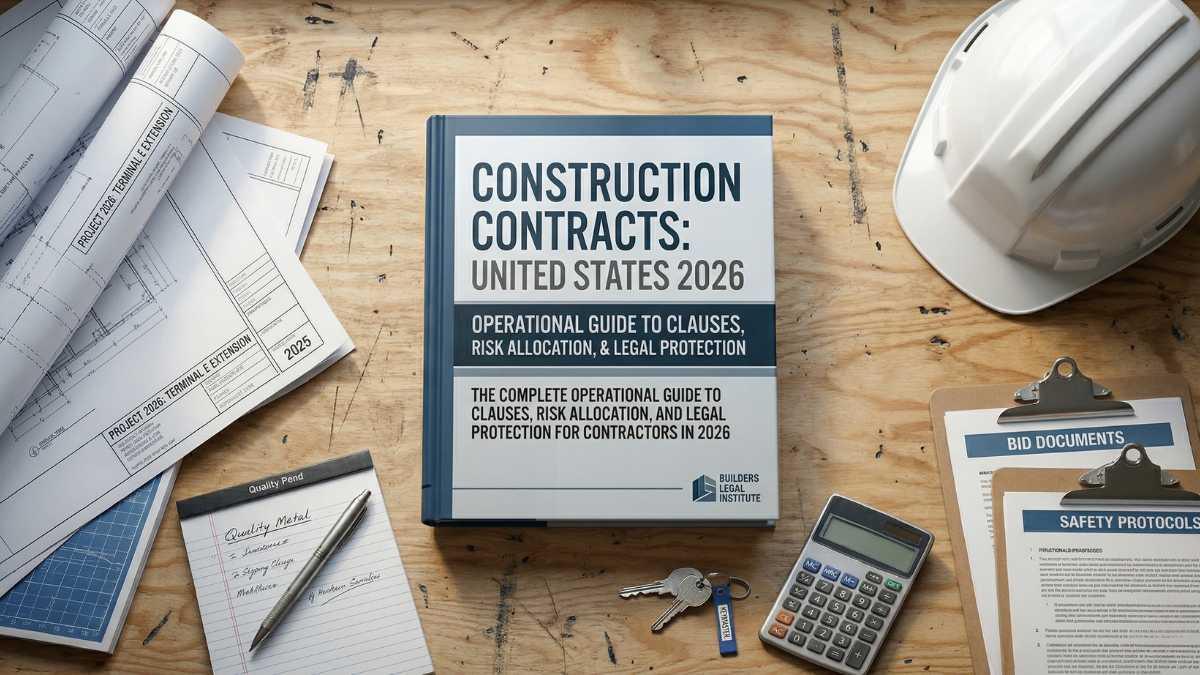
Construction contracts in the United States have always been the backbone of project execution, but in 2026, they have become something much more critical: they are the primary system for risk control in an increasingly unstable environment. While many contractors still view contracts as formalities or legal requirements handled by attorneys, the reality is that contracts now directly determine profitability, schedule stability, dispute exposure, and operational control.
Across the U.S., the complexity of construction projects has increased. Financing structures are more sensitive to interest rates, material costs remain volatile, subcontractor performance is less predictable, and regulatory frameworks continue to evolve at federal, state, and local levels. In this context, contracts are no longer static documents — they are dynamic instruments that define how risk is distributed across all parties involved.
The problem is that most contractors do not read contracts operationally.
They read them legally.
This creates a dangerous gap.
A contract may be legally sound but operationally unbalanced. It may comply with regulations but still expose the contractor to delays, cost overruns, and disputes that could have been mitigated with better clause structuring and negotiation.
Serious contractors in 2026 are no longer delegating contracts entirely to legal teams. They are integrating contract analysis into their operational strategy, ensuring that every clause aligns with real-world execution.
This article is not a generic overview of construction contracts. It is a deep operational guide to how contracts actually work in the United States today — and how contractors must read, negotiate, and structure them to protect their projects.
WHY CONSTRUCTION CONTRACTS ARE NOW THE PRIMARY RISK CONTROL SYSTEM
The traditional view of contracts as legal protection tools is incomplete. In modern construction, contracts are operational control systems that define how every major variable will behave under pressure.
When a project encounters delays, the contract determines who is responsible and how extensions are granted.
When material prices fluctuate, the contract defines whether adjustments are allowed.
When disputes arise, the contract dictates how they are resolved and at what cost.
Without clear contractual structure, contractors are exposed to uncertainty that cannot be managed in real time.
In the United States, multiple standard contract frameworks exist, including those developed by the American Institute of Architects (AIA) and the Associated General Contractors of America (AGC). These frameworks provide baseline structures, but they are rarely used without modification.
Each project introduces custom conditions, and these modifications are where most risk is hidden.
Government-related projects add another layer of complexity. Contractors working on federally funded or regulated projects must comply with requirements from agencies such as the U.S. General Services Administration (GSA) and guidelines available at the official portal of the USA.gov, where procurement rules and compliance expectations are defined.
The contract is not just a document.
It is the rulebook for everything that can go wrong.
THE CORE STRUCTURE OF U.S. CONSTRUCTION CONTRACTS
At a structural level, most construction contracts in the United States follow a consistent framework, regardless of project size or sector. Understanding this structure is essential before analyzing individual clauses.
The agreement itself defines the parties, project scope, and overall contractual relationship. It establishes the legal identity of the contractor, owner, and other stakeholders.
The general conditions define how the project will be managed. This includes responsibilities, communication protocols, schedule management, and dispute resolution mechanisms. This section is where most operational rules are established.
Supplementary conditions modify the general conditions to reflect project-specific requirements. This is one of the most critical areas because it often contains custom clauses that override standard protections.
The scope of work defines what is included and excluded from the contractor’s responsibilities. Any ambiguity here becomes a future dispute.
The schedule establishes timelines, milestones, and completion requirements. In 2026, schedule clauses are increasingly strict due to financing and market pressures.
The payment terms define how and when the contractor will be compensated, including progress payments, retainage, and conditions for release of funds.
Each of these components interacts with the others. A change in one area can affect the entire contract.
Builder Inteligence

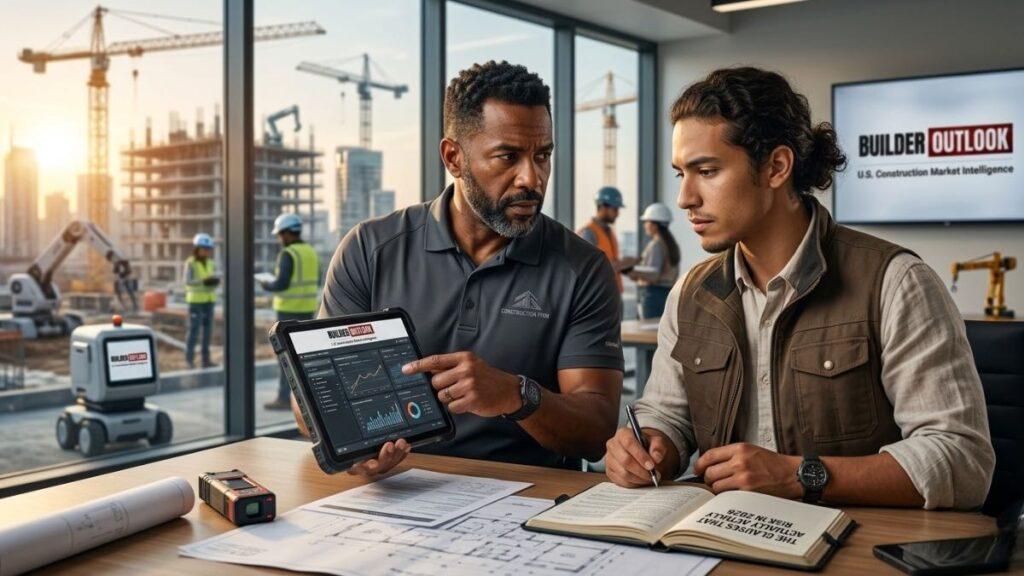
THE CLAUSES THAT ACTUALLY DEFINE RISK IN 2026
Not all contract clauses carry the same weight. In the current environment, certain clauses have a disproportionate impact on project outcomes.
The scope definition clause is one of the most critical. Any lack of clarity creates exposure to additional work without compensation. Contractors must ensure that scope boundaries are explicitly defined and that assumptions are documented.
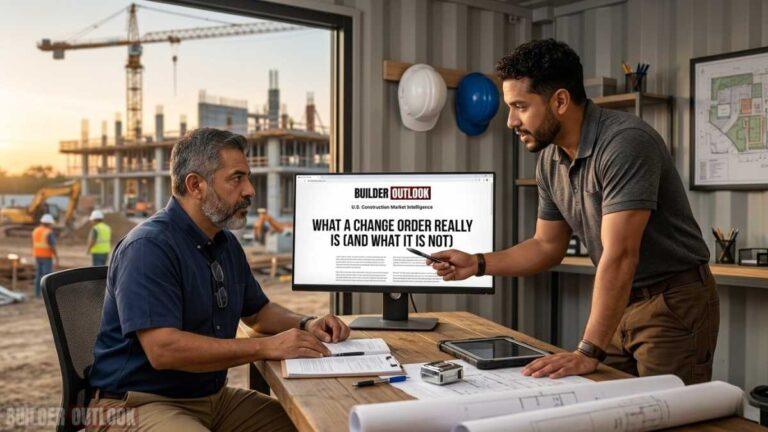
The change order clause determines how modifications to the project are handled. Without a clear and enforceable process, contractors may be forced to perform additional work without timely approval or compensation.
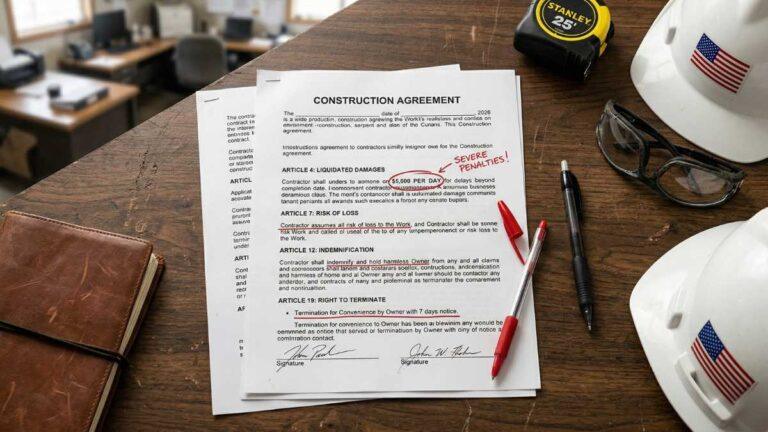
The schedule and delay clause defines how time-related issues are managed. This includes provisions for extensions, liquidated damages, and responsibility for delays. In many contracts, these clauses are structured in a way that transfers risk to the contractor.
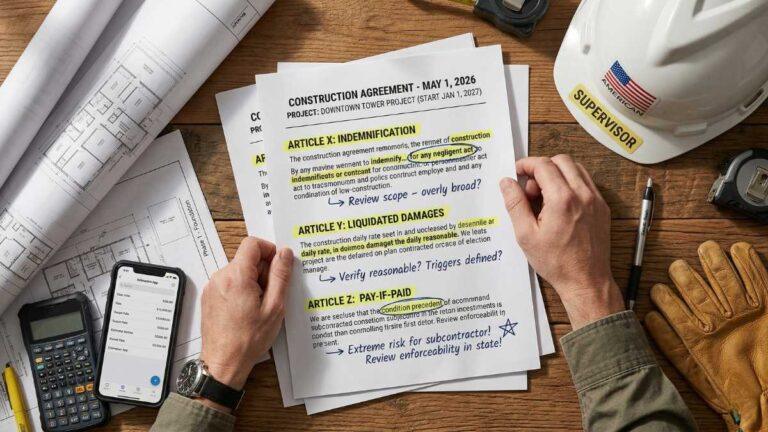
The payment clause controls cash flow. Delays in payment can create significant operational challenges, especially for contractors managing multiple projects. Pay-if-paid and pay-when-paid provisions must be carefully analyzed.
The indemnification clause defines liability. Contractors must understand the extent to which they are responsible for damages, including those caused by third parties.
The dispute resolution clause determines how conflicts are handled. Whether disputes are resolved through litigation, arbitration, or mediation has a direct impact on cost and timeline.
Each of these clauses must be evaluated not only for legal compliance but for operational impact.
WHAT CONTRACTORS GET WRONG WHEN REVIEWING CONTRACTS
The most common mistake is assuming that standard contracts are balanced by default. While organizations like AIA and AGC provide well-structured templates, modifications introduced by owners or developers can significantly alter risk allocation.
Another mistake is focusing only on major clauses while ignoring smaller provisions. In many cases, risk is hidden in seemingly minor sections such as definitions, notice requirements, or administrative procedures.
Contractors also frequently underestimate the importance of timing requirements. Many contracts include strict deadlines for submitting claims, change orders, or notices. Missing these deadlines can result in loss of rights.
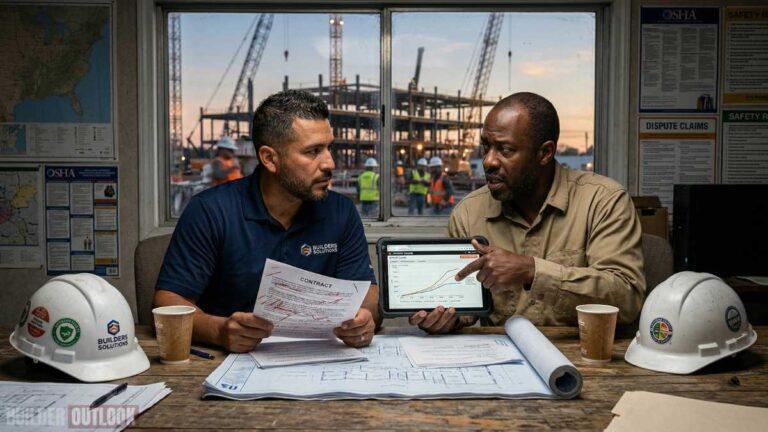
There is also a tendency to rely entirely on legal teams without involving operational leadership. Attorneys may ensure legal compliance, but they may not fully understand how clauses affect day-to-day execution.
Finally, contractors often fail to compare contracts across projects. Without a consistent evaluation framework, it becomes difficult to identify patterns of risk.
HOW HIGH-PERFORMANCE CONTRACTORS NEGOTIATE CONTRACTS
Contract negotiation is not about eliminating risk. It is about allocating it in a way that is manageable.
Leading contractors approach negotiation with a clear understanding of which clauses are non-negotiable and which can be adjusted. They prioritize areas that directly impact cost, schedule, and liability.
They also prepare data to support their position. Instead of relying on generic arguments, they use past project performance, market conditions, and operational constraints to justify requested changes.
Communication is critical. Contractors engage with owners early, explaining how certain clauses may affect project outcomes. This shifts the conversation from confrontation to alignment.
Another key strategy is consistency. Contractors develop internal standards for contract review and negotiation, ensuring that decisions are not made on a case-by-case basis without structure.
Finally, they involve multiple stakeholders in the review process, including estimating, operations, and legal teams. This creates a more complete understanding of the contract.
THE ROLE OF GOVERNMENT REGULATIONS IN CONTRACT STRUCTURE
Government regulations influence construction contracts at multiple levels. Contractors must be aware of federal, state, and local requirements that affect project execution.
Federal projects, for example, often require compliance with the Federal Acquisition Regulation (FAR), which defines procurement rules and contract structures. Information about these requirements can be accessed through official government resources such as the General Services Administration.
Labor regulations, safety standards, and environmental requirements also impact contract terms. Agencies such as the Occupational Safety and Health Administration (OSHA) establish guidelines that may be incorporated into contractual obligations.
Failure to align contracts with regulatory requirements can result in penalties, delays, and legal exposure.
Contracts do not exist in isolation.
They operate within a regulatory ecosystem.
Construction contracts in the United States are no longer passive documents. They are active systems that define how projects will perform under pressure.
Contractors who treat contracts as legal formalities will continue to face avoidable risks. Those who approach them as operational tools will gain control over cost, schedule, and execution.
In 2026, the difference between a profitable project and a problematic one is often determined before construction even begins.
It is determined in the contract.
More from Builder Inteligence

FAQ – Construction contracts in the United States: the complete operational guide to clauses, risk allocation, and legal protection for contractors in 2026
1. What is the most important part of a construction contract?
The clauses related to scope, payment, schedule, and liability, as they directly impact project execution and risk.
2. Are standard contracts like AIA always safe to use?
No. Modifications can significantly change risk allocation, so each contract must be reviewed carefully.
3. What is a pay-if-paid clause?
It is a provision that makes the contractor’s payment to subcontractors conditional on receiving payment from the owner.
4. Why are change order clauses important?
They define how additional work is approved and compensated, preventing disputes during execution.
5. How do contracts affect project profitability?
They determine how risks are allocated, which directly influences costs, delays, and overall financial outcomes.
6. Should contractors involve operational teams in contract review?
Yes. Operational insight is essential to understanding how clauses will impact execution.
7. What role do government regulations play in contracts?
They define compliance requirements that must be incorporated into contract terms.
8. Can contract risks be eliminated?
No, but they can be managed and reduced through careful review and negotiation.