In the United States construction industry, most contractors believe they understand contracts.
They recognize standard terms.
They skim key sections.
They rely on legal teams for final approval.
And then they sign.
The problem is not that contractors ignore contracts.
The problem is that they underestimate where the real risk is hidden.
In 2026, construction contracts are no longer straightforward agreements defining scope and payment. They are complex frameworks designed to distribute risk — often in ways that are not immediately visible. The most dangerous clauses are not always the ones that look aggressive. They are the ones that appear standard but contain subtle language shifts that transfer responsibility without clear visibility.
Across the U.S., contractors are facing increasing pressure from owners and developers who are restructuring contracts to protect themselves against uncertainty. This includes stricter schedule enforcement, tighter payment conditions, expanded liability provisions, and more rigid administrative requirements.
At the same time, contractors are operating in an environment with unstable labor availability, fluctuating costs, and evolving regulatory frameworks.
This combination creates a critical reality:
Signing a contract without deep operational understanding is no longer acceptable.
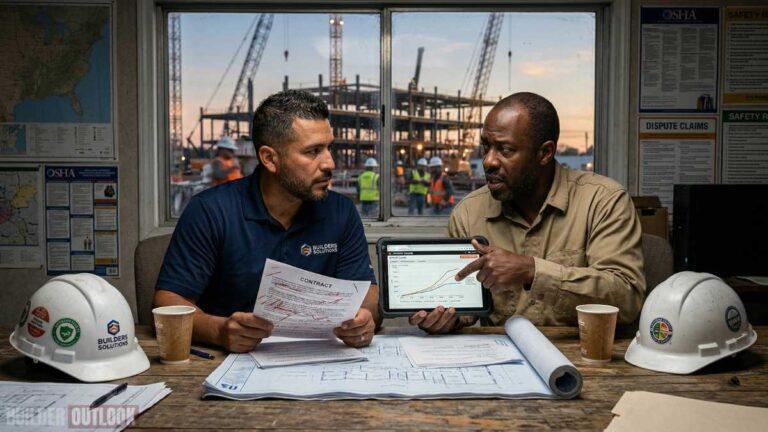
The contractors who are maintaining profitability and reducing disputes in 2026 are not just reading contracts — they are dissecting them. They understand how each clause behaves under real project conditions and how it impacts execution.
This article breaks down the most important contract clauses that contractors in the United States must review before signing, how these clauses actually function in practice, and how hidden risk is embedded in language that often goes unnoticed.
WHY CONTRACT CLAUSES ARE THE TRUE CONTROL POINT OF PROJECT RISK
Every construction project operates under uncertainty.
Delays happen.
Costs change.
Conditions evolve.
The contract determines how those uncertainties are handled.
Without clear contractual structure, risk becomes unpredictable. With structured clauses, risk becomes defined — even if it is not eliminated.
The issue is that many contractors focus on the existence of clauses, not their behavior.
Two contracts may contain similar clauses but produce completely different outcomes depending on how they are written.
For example, a delay clause may allow for time extensions under certain conditions — or it may restrict them through strict notice requirements and documentation rules.
A payment clause may define when payment is due — but also include conditions that effectively delay or restrict access to funds.
Understanding clauses requires more than reading.
It requires interpretation.
THE SCOPE CLAUSE: WHERE MOST DISPUTES BEGIN
The scope clause is the foundation of the contract.
It defines what the contractor is responsible for — and just as importantly, what is excluded.
In theory, scope should be clear.
In practice, it rarely is.
Drawings may contain inconsistencies. Specifications may be incomplete. Interfaces between trades may not be fully defined. These gaps create areas where responsibility is unclear.
Contract language often attempts to address this by including phrases such as “all work necessary for completion” or “as required for a fully functional system.”
These phrases appear harmless.
They are not.
They expand the contractor’s responsibility beyond what is explicitly documented.
Contractors must analyze scope not only based on documents, but based on interpretation. Any ambiguity should be clarified before signing.
If not, it becomes the contractor’s problem during execution.
CHANGE ORDER CLAUSES: CONTROL OR CHAOS
Change orders are inevitable in construction.
The question is not whether they will happen.
It is how they will be handled.
A well-structured change order clause defines a clear process for identifying, pricing, approving, and executing changes. It ensures that additional work is recognized and compensated.
A poorly structured clause creates uncertainty.
Some contracts require written approval before any change is performed. Others allow work to proceed with delayed approval. Some impose strict timelines for submitting claims, while others leave room for interpretation.
The risk is not just in the process.
It is in enforcement.
Contractors who perform work without proper documentation may lose the right to compensation, even if the work was necessary.
This makes change order clauses one of the most critical areas of contract review.
Builder Inteligence
Advertising


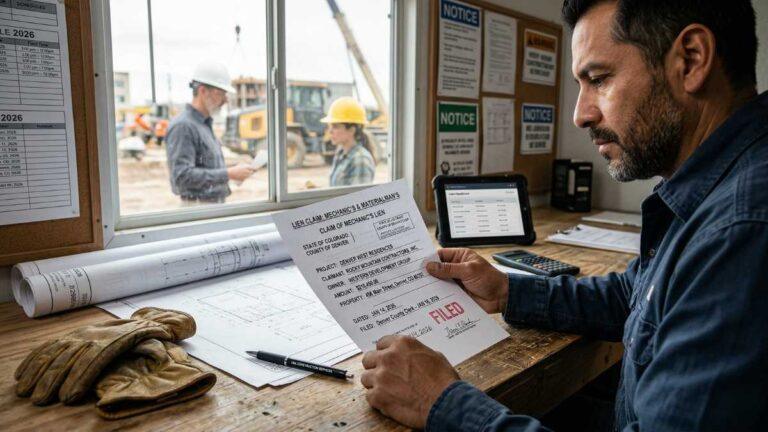
PAYMENT CLAUSES: CASH FLOW IS CONTROL
Profitability in construction is not just about margin.
It is about cash flow.
Payment clauses define how and when contractors are paid. In 2026, these clauses are becoming increasingly complex.
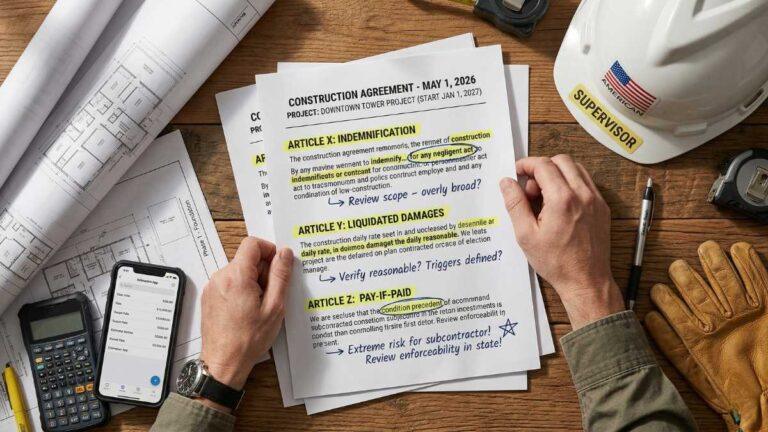
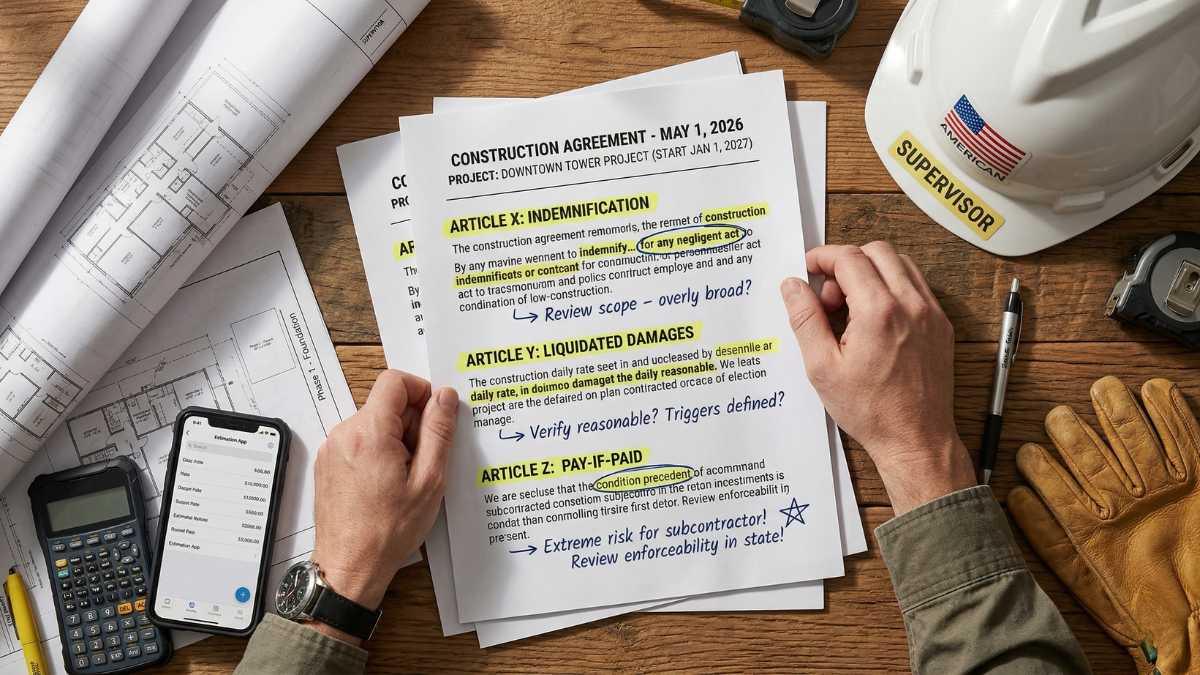
One of the most critical provisions is the “pay-if-paid” clause, which ties the contractor’s payment to the owner’s payment to the general contractor. This shifts financial risk down the chain.
Another key factor is retainage — the portion of payment withheld until project completion. High retainage percentages can create significant cash flow pressure.
Payment timelines are also important. Delays in payment can affect the contractor’s ability to manage labor, materials, and subcontractors.
Government-backed guidelines, including those outlined by the U.S. Small Business Administration and procurement frameworks referenced through USA.gov, highlight the importance of fair payment practices, especially in public projects.
Contractors must evaluate payment clauses not just for legality, but for operational impact.
SCHEDULE AND DELAY CLAUSES: THE COST OF TIME
Time is one of the most valuable and volatile elements in construction.
Schedule clauses define deadlines, milestones, and consequences for delays.
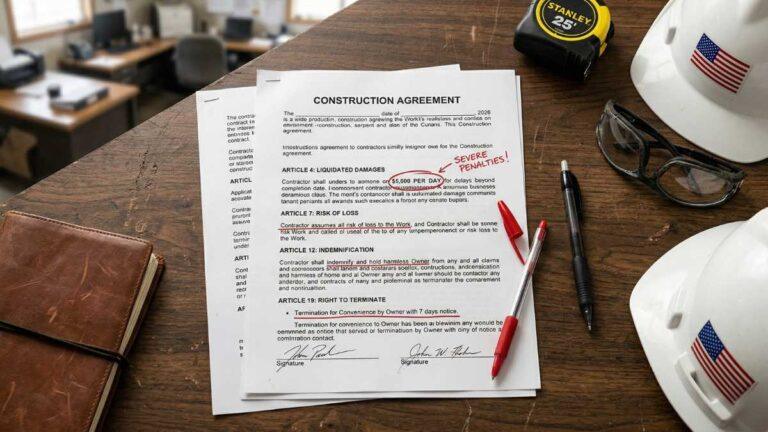
In many contracts, delay provisions are structured to protect the owner, often including liquidated damages — predetermined penalties for late completion.
The critical issue is how delays are defined and attributed.
Contracts may distinguish between excusable and non-excusable delays, compensable and non-compensable delays. These distinctions determine whether the contractor is entitled to time extensions or additional compensation.
Notice requirements are another key factor. Contractors may be required to notify the owner within a specific timeframe after a delay occurs. Failure to comply can result in loss of rights.
In fast-paced projects, these requirements can be difficult to manage without structured systems.
INDEMNIFICATION AND LIABILITY CLAUSES: WHERE EXPOSURE IS HIDDEN
Indemnification clauses define responsibility for damages and claims.
In many contracts, these clauses extend beyond direct responsibility, requiring contractors to cover damages caused by third parties or unforeseen conditions.
This creates significant exposure.
Insurance requirements are often linked to indemnification clauses, but they do not always cover all scenarios.
Contractors must understand the limits of their coverage and how it aligns with contractual obligations.
Failing to do so can result in financial exposure that exceeds project value.
DISPUTE RESOLUTION CLAUSES: HOW CONFLICTS ARE CONTROLLED
Disputes are not optional.
They are part of the construction process.
The contract determines how they are resolved.
Some contracts require mediation before escalation. Others mandate arbitration or litigation. Each method has different implications in terms of cost, timeline, and control.
The choice of jurisdiction and governing law also affects dispute resolution.
Contractors must evaluate whether the process is practical and aligned with their resources.
A dispute clause that appears neutral can become a significant disadvantage if it limits the contractor’s ability to defend their position effectively.
HOW HIGH-PERFORMANCE CONTRACTORS REVIEW CONTRACTS
Contract review is not a checklist.
It is a system.
High-performance contractors approach contracts with a structured methodology.
They analyze clauses based on impact, not just presence.
They involve multiple departments in the review process.
They compare contracts across projects to identify patterns.
They prioritize negotiation on high-impact areas.
Most importantly, they align contract terms with operational reality.
This alignment is what separates controlled projects from chaotic ones.
In 2026, construction contracts in the United States are not just legal documents.
They are operational blueprints that define how projects will perform under pressure.
Contractors who fail to understand clause behavior will continue to face avoidable risk.
Those who master contract analysis will gain control over cost, schedule, and execution.
The difference is not in the contract itself.
It is in how it is read.
More from Builder Inteligence


FAQ – The most important construction contract clauses to review in the United States in 2026: how contractors identify hidden risk before signing
1. What is the most important clause in a construction contract?
Scope, payment, and delay clauses are among the most critical due to their direct impact on execution.
2. Why are contract clauses more important in 2026?
Because increased market uncertainty amplifies the impact of risk allocation.
3. What is a pay-if-paid clause?
A clause that conditions contractor payment on receiving payment from the owner.
4. How do change order clauses affect projects?
They define how additional work is handled and whether it will be compensated.
5. Why are delay clauses risky?
Because they often include penalties and strict requirements that limit contractor flexibility.
6. What is indemnification in construction?
It is a provision that assigns responsibility for damages and claims.
7. How can contractors reduce contract risk?
By analyzing clauses deeply and negotiating terms before signing.
8. Should contracts always be negotiated?
Yes. Even standard contracts can contain modifications that shift risk.