Contractors who operate in multiple regions often encounter a major question when expanding their business: can a contractor license issued in one state be used in another? The answer depends on a regulatory concept known as contractor license reciprocity. Reciprocity agreements between states allow licensed contractors to work across state lines without completing the entire licensing process from the beginning.
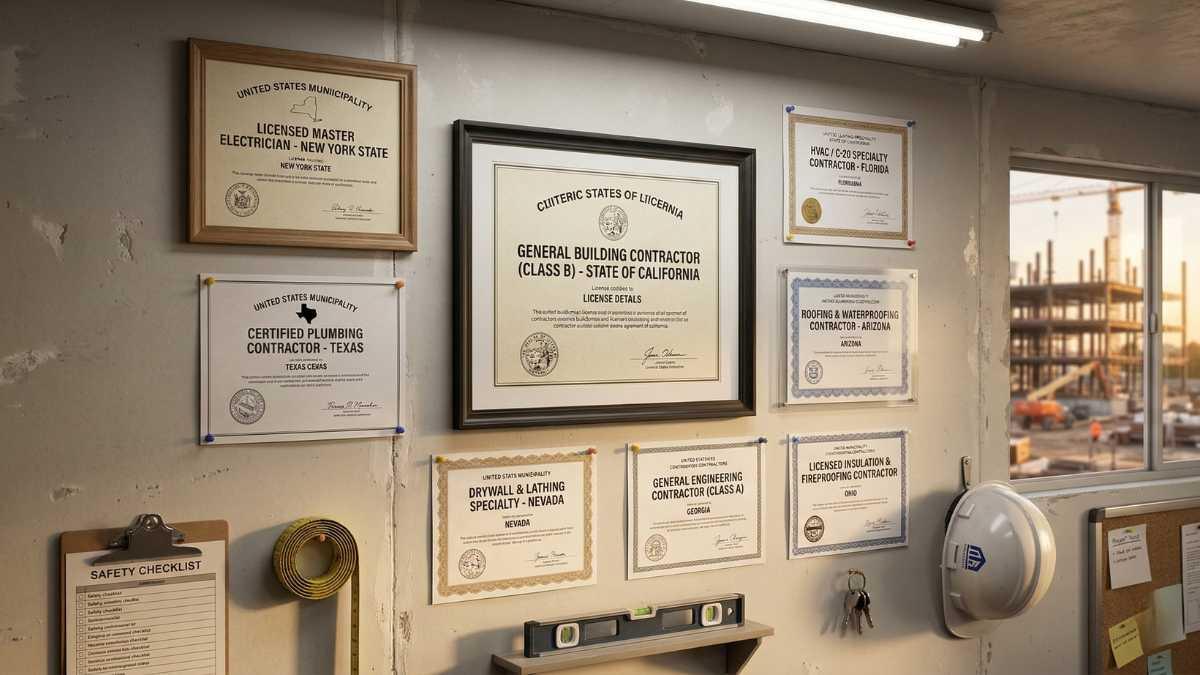
Because construction licensing in the United States is regulated primarily at the state level, each state establishes its own licensing requirements. These requirements may include experience verification, licensing exams, insurance coverage, bonding requirements, and business registration. As a result, a contractor license issued in one state does not automatically grant permission to operate in another state.
However, some states recognize licenses issued by certain other states through reciprocity agreements. These agreements simplify the process for contractors who want to expand their operations into neighboring states or regions with strong economic connections. Instead of repeating the entire licensing process, contractors may be able to apply for a license through an abbreviated application procedure.
For contractors planning regional growth, understanding contractor license reciprocity between states is essential. Reciprocity can significantly reduce the time and administrative complexity involved in expanding into new markets while still ensuring that contractors meet professional standards.
What contractor license reciprocity means
Contractor license reciprocity refers to an agreement between two states that allows licensed contractors from one state to obtain a license in the other without repeating the full licensing process. These agreements are typically based on the assumption that both states maintain similar licensing standards.
When reciprocity exists, contractors may not need to complete the entire licensing process again. Instead, they may only need to submit documentation proving that they hold an active license in their original state and that their license is in good standing.
In many cases, contractors applying through reciprocity must still complete administrative steps such as submitting applications, paying licensing fees, and verifying insurance coverage. However, they may be exempt from certain requirements, such as trade exams or experience documentation.
Reciprocity agreements vary widely between states. Some states have multiple reciprocity agreements, while others maintain very limited recognition of licenses issued elsewhere.
States that commonly offer contractor license reciprocity
Several states have reciprocity agreements designed to make it easier for contractors to operate across state lines. These agreements often exist between neighboring states with similar regulatory frameworks.
For example, states in the southeastern United States frequently maintain reciprocity arrangements because construction companies often operate across multiple state borders within the region. These agreements allow contractors to expand into nearby markets without restarting the entire licensing process.
Similarly, states in the southwestern and western regions may recognize certain licenses issued by other states if their licensing standards are considered comparable. In these cases, contractors must usually submit documentation proving that they passed similar exams and meet equivalent experience requirements.
Despite these agreements, reciprocity rarely provides full automatic licensing. Contractors usually still need to complete an application process with the new state’s licensing board.
When contractors still need to take licensing exams
Even when reciprocity agreements exist, contractors may still be required to complete certain licensing exams. This typically happens when the receiving state requires exams covering topics specific to its regulatory system.
For example, a state may require contractors to pass a business law or construction law exam that focuses on that state’s regulations, building codes, and licensing rules. These exams ensure that contractors understand local legal requirements even if they have already demonstrated technical knowledge in another state.
In some cases, reciprocity may apply only to specific license classifications. For example, a general contractor license may qualify for reciprocity while a specialty trade license does not.
Because of these variations, contractors should carefully review reciprocity policies before assuming that their license will be recognized elsewhere.
Documentation required for reciprocity applications
Contractors applying for a license through reciprocity typically need to provide several types of documentation to the receiving state’s licensing authority.
Common documentation requirements include:
• proof of an active contractor license in the original state;
• verification that the license is in good standing;
• documentation of passing licensing exams;
• proof of insurance coverage;
• application forms and licensing fees;
In some cases, contractors must request official license verification from the licensing board in their original state. This verification confirms that the contractor has no disciplinary actions and maintains a valid license.
Providing accurate documentation is essential for reciprocity applications because licensing boards rely on this information to determine whether the contractor meets equivalent regulatory standards.
Why reciprocity matters for construction businesses
For construction companies planning regional growth, reciprocity agreements can significantly simplify expansion strategies. Contractors operating near state borders often work on projects that cross jurisdictional boundaries, making reciprocity especially valuable.
Without reciprocity, contractors would need to complete the full licensing process for every state where they plan to operate. This could involve repeating experience verification, completing new exams, and submitting extensive documentation.
Reciprocity allows contractors to leverage their existing credentials and demonstrate that they already meet professional standards established by other states. This not only reduces administrative burdens but also helps construction businesses respond more quickly to new project opportunities.
As the construction industry continues to expand across regional markets, contractor license reciprocity will remain an important mechanism for supporting mobility and growth within the industry.
More from Builder Inteligence
FAQ – Contractor license reciprocity between states
1. What is contractor license reciprocity between states?
Contractor license reciprocity refers to agreements between states that allow contractors licensed in one state to apply for a license in another state through a simplified process. Instead of repeating the full licensing procedure, contractors may only need to submit documentation and meet administrative requirements.
2. Does contractor license reciprocity allow contractors to work automatically in another state?
No. Reciprocity does not automatically grant permission to work in another state. Contractors must still apply for a license in the new state, but they may be exempt from certain steps such as experience verification or trade exams.
3. Why do states offer contractor license reciprocity agreements?
Reciprocity agreements help facilitate economic activity by allowing contractors to operate across state borders while maintaining professional licensing standards. They are particularly useful in regions where construction companies frequently work in multiple neighboring states.
4. Do all states offer contractor license reciprocity?
No. Some states maintain reciprocity agreements with multiple states, while others recognize very few licenses issued elsewhere. Contractors must check the specific policies of each state licensing board.
5. Do contractors still need to take exams when applying through reciprocity?
In some cases yes. Even when reciprocity exists, contractors may still be required to take exams covering state-specific construction laws or business regulations.
6. What documents are required to apply for contractor license reciprocity?
Applicants usually must provide proof of an active license, verification that the license is in good standing, documentation of passing exams, insurance coverage, and completed application forms.
7. Can reciprocity apply to all types of contractor licenses?
Not always. Some states limit reciprocity to specific license classifications such as general contractor licenses while excluding certain specialty trades.
8. Why is reciprocity important for construction businesses expanding into new markets?
Reciprocity allows contractors to expand their operations more efficiently by reducing the administrative burden associated with obtaining new licenses in multiple states.