Local SEO for contractors has quietly become one of the most decisive growth levers for construction companies in the United States. While many contractors still associate search optimization with blogs or national rankings, the real battlefield is local intent. When a potential client types “general contractor near me,” “commercial builder near me,” or “construction company in [city],” they are not researching. They are shortlisting. At that moment, visibility is not marketing. It is market access. Contractors who do not appear in these searches are effectively invisible at the exact moment demand is expressed.
What makes local SEO particularly powerful is that it compresses the sales cycle. Unlike ads or social content that create awareness over time, local searches signal immediate need. These users are already problem-aware, budget-aware, and timeline-aware. They are not browsing. They are choosing. This is why dominating “near me” searches consistently delivers higher-quality leads than most outbound efforts. However, domination does not happen by accident or by filling out a few fields on a Google Business Profile. It requires structural alignment between operations, content, authority, and geography.
Another critical reality is that local SEO for contractors is no longer just about proximity. Google increasingly evaluates relevance, credibility, and activity. A contractor five miles away with weak signals will lose to a contractor ten miles away with strong proof, better reviews, clearer services, and consistent local content. This shift has changed the rules. Local SEO is now a competitive system, not a checkbox.
More from Builder Inteligence

Why “near me” searches are a battleground, not a feature
“Near me” searches have exploded because they remove friction from decision-making. Buyers no longer want lists, directories, or referrals alone. They want fast validation. Google has become the first estimator, the first prequalification step, and the first risk filter. When your company appears prominently with strong signals, you are perceived as established, active, and safe. When you do not appear, you are assumed to be unavailable, irrelevant, or too small.
Many contractors misunderstand why they do not rank. They assume it is a technical issue or a budget issue. In reality, it is usually a signal issue. Google mirrors buyer behavior. If your company does not clearly communicate what you do, where you do it, and why you are trusted locally, Google cannot confidently recommend you. Rankings follow clarity, not effort.
Another overlooked factor is specialization. Contractors who try to rank for everything often rank for nothing. Local SEO rewards focus. A contractor who clearly positions themselves as a commercial tenant improvement specialist in Phoenix or a residential remodeler in Boca Raton sends stronger relevance signals than a generic “full-service contractor” everywhere. Specificity increases visibility.
Finally, inactivity is punished. Profiles that are not updated, reviewed, or reinforced through content slowly decay. Local SEO for contractors is not static. It reflects momentum. Contractors who treat it as a living asset dominate those who treat it as a setup task.
The operational foundations of strong local SEO for contractors
Strong local SEO starts with operational consistency. Your company name, address, phone number, and service descriptions must match across your website, Google Business Profile, directories, and citations. Inconsistencies create doubt for algorithms and users. Doubt reduces rankings. Consistency reinforces legitimacy.
Next comes content localization. This goes beyond listing cities. It means creating pages, case studies, and explanations that reference real projects, neighborhoods, regulations, and conditions in your service area. Google favors contractors who demonstrate local experience, not just local presence. This is especially critical in construction, where regional codes, climate, and labor conditions matter.
Reviews are another operational mirror. High-quality, recent, descriptive reviews signal active operations and satisfied clients. Contractors who do not manage reviews are leaving rankings to chance. Responding to reviews, encouraging feedback, and addressing issues publicly all strengthen local authority.
Finally, performance matters. Slow websites, broken pages, or poor mobile experience directly harm local rankings. Most “near me” searches happen on mobile. If your site does not load quickly or clearly communicate value on a phone, visibility and conversions collapse simultaneously.
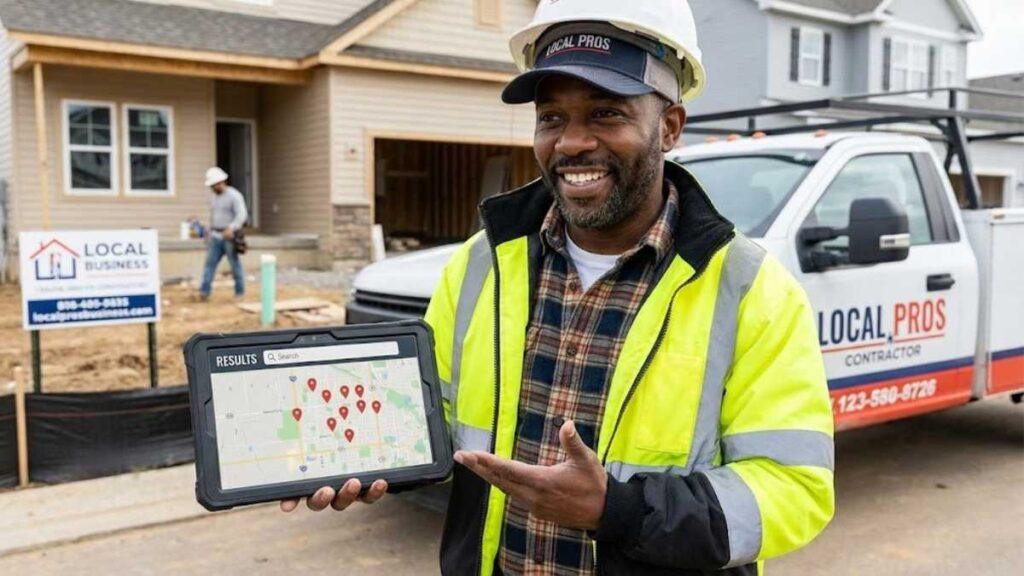
How contractors actually dominate local search results
Domination requires alignment, not tricks. Contractors must decide which services they want to be known for in which locations. Then every signal must reinforce that decision. Service pages, Google categories, project content, reviews, and backlinks should all point in the same direction. This creates algorithmic confidence.
Another key factor is authority beyond your own site. Local backlinks from chambers of commerce, suppliers, trade associations, and local publications significantly strengthen rankings. These links act as third-party validation of your local relevance and legitimacy.
Publishing consistently also matters. Contractors who publish local insights, project updates, permitting explanations, or market commentary send freshness signals that competitors often lack. This content does not need to go viral. It needs to be relevant and local.
Ultimately, contractors who dominate “near me” searches treat local SEO for contractors as infrastructure. It is not a campaign. It is a system that compounds over time. Once established, it becomes one of the lowest-cost, highest-intent acquisition channels available in construction.
Builder Inteligence
Frequently Asked Questions
1. What makes local SEO different from general SEO for contractors?
Local SEO focuses on geographic intent and immediate demand rather than broad informational traffic. It prioritizes proximity, relevance, reviews, and local authority. For contractors, this means appearing when buyers actively search for services in a specific city or region, not just ranking for generic construction terms.
2. How long does it take for contractors to see results from local SEO?
Results vary, but contractors typically see measurable improvements within three to six months when signals are aligned correctly. Factors include competition, current visibility, review profile, and content quality. Local SEO compounds over time, making early consistency critical for long-term dominance.
3. Are Google Business Profiles enough to rank locally?
No, Google Business Profiles are necessary but not sufficient. Rankings depend on website quality, localized content, reviews, backlinks, and operational consistency. Contractors who rely only on profile optimization rarely dominate competitive markets.
4. Do reviews really impact “near me” rankings?
Yes, reviews strongly influence both rankings and click-through rates. Google uses review quantity, frequency, and relevance as trust signals. Buyers also rely on reviews to reduce risk, making them a critical conversion factor in local search results.
5. Can small contractors compete with larger companies in local SEO?
Yes, local SEO often favors focus over size. Small contractors with clear specialization, strong local content, and active review management can outrank larger competitors that lack consistency or relevance in a specific market.