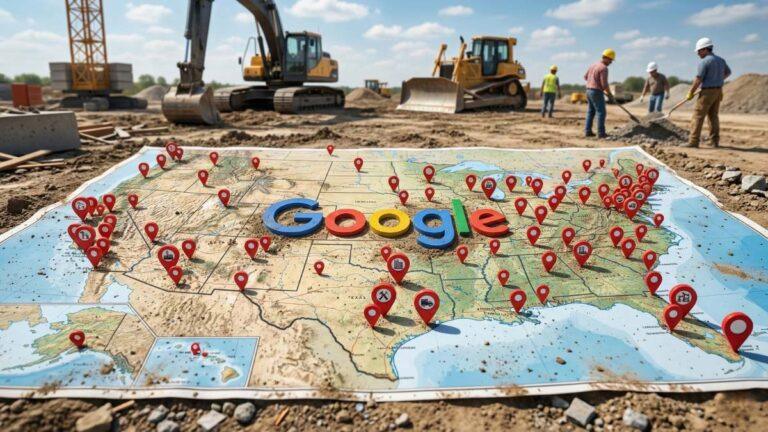
The American construction industry is undergoing a structural transformation. Demand cycles are tightening, labor remains constrained, material pricing volatility persists, and competition for profitable projects is intensifying across residential, commercial, and specialty sectors. In this environment, relying exclusively on referrals, legacy relationships, or repeat clients is no longer a sustainable growth model. Digital visibility has become operational infrastructure. Contractors who fail to understand this shift are not simply missing opportunities — they are slowly losing negotiating power in their own markets.
Digital marketing for construction companies is often misunderstood as social media posting or occasional paid ads. That narrow interpretation is precisely why most builders fail to generate consistent, qualified leads online. True digital strategy in construction is about building an ecosystem that captures high-intent search traffic, positions the company as an authority, filters out price shoppers, and creates a predictable pipeline aligned with margin goals. It is a system, not a tactic.
Across the United States — whether in Texas commercial development corridors, Florida residential expansion zones, or Midwest industrial retrofits — the decision-making process has shifted upstream. Owners search before they call. Developers analyze online credibility before scheduling meetings. Even subcontractors evaluate a general contractor’s digital footprint before entering agreements. Visibility now shapes perception long before a bid is submitted. Contractors who ignore this reality operate at a structural disadvantage.
The companies that dominate search results for phrases like “commercial general contractor in Houston” or “industrial HVAC contractor in Chicago” are not there by accident. They have invested in technical SEO infrastructure, content authority, geographic targeting, and structured conversion funnels. This is not marketing noise. It is competitive positioning embedded into business operations. In 2026, digital marketing for construction companies is less about promotion and more about control — control over pipeline, reputation, margin, and growth trajectory.
Builder Inteligence

The real reason most construction companies fail at digital marketing
The primary reason construction firms struggle online is not lack of budget. It is lack of structural thinking. Many contractors approach digital marketing as an outsourced service rather than an integrated strategic layer. They hire agencies to “run ads” or “do SEO” without understanding how those elements connect to revenue stability, pricing power, and long-term valuation.
Construction is operationally demanding. Owners are consumed by project timelines, subcontractor coordination, regulatory compliance, workforce management, and material procurement. Marketing becomes reactive — something addressed only when pipeline pressure increases. But digital authority compounds. SEO trust accumulates. Backlink equity strengthens. Domain authority matures. The longer a contractor delays structured digital positioning, the wider the competitive gap becomes.
Another common failure point is misalignment between marketing messaging and business model. A commercial contractor seeking multimillion-dollar projects cannot rely on generic messaging or low-cost lead funnels. High-value projects require authority positioning, risk-awareness content, compliance signaling, and credibility markers that sophisticated buyers evaluate carefully. Digital marketing for construction companies must reflect operational maturity — not superficial branding.
Finally, many contractors chase traffic instead of targeting intent. Ranking for broad, irrelevant keywords creates vanity metrics, not revenue. The goal is not maximum clicks. The goal is high-intent visibility aligned with service specialization and geographic reach. Without that clarity, marketing investment becomes diluted and ineffective.
Building a search dominance strategy in construction
Search engine optimization for construction companies is fundamentally geographic and service-specific. It is not about national brand awareness unless the firm operates at national scale. It is about owning targeted search territory in defined markets.
A contractor specializing in commercial concrete work in Phoenix must build SEO around highly specific phrases: “commercial concrete contractor Phoenix,” “structural concrete services Arizona,” “warehouse slab contractor Phoenix metro,” and related high-intent variations. Each service line requires its own structured page, supported by internal linking, project case studies, and contextual authority content.
Technical performance also plays a critical role. Google increasingly evaluates user experience signals such as load speed, mobile responsiveness, and site architecture clarity. A slow, poorly structured website undermines credibility and ranking potential. In construction, where trust and professionalism are paramount, a technically optimized site reinforces operational competence.
Equally important is authority content. Publishing in-depth market analysis, regulatory updates, labor trend commentary, cost forecasting insights, and safety compliance discussions signals industry expertise. Google rewards topical authority. Owners reward perceived competence. When a contractor consistently publishes detailed, analytical content, it strengthens both ranking capacity and brand perception.
Authority positioning and its impact on margin
In construction, perception directly influences pricing leverage. Contractors who appear commoditized are forced into competitive bidding environments dominated by cost comparison. Contractors who project authority command negotiation power.
Digital marketing, when executed strategically, reshapes perception. Instead of being “another bidder,” the company becomes an informed market participant. Publishing thought leadership on housing starts trends, workforce shortages, material pricing outlook, and policy shifts positions the contractor as proactive and informed. Clients interpret that as risk mitigation — and risk mitigation justifies premium pricing.
This shift is critical in 2026. With rising labor costs and fluctuating materials, protecting margin is more important than chasing volume. Digital authority filters out clients whose primary decision factor is lowest price. It attracts owners who value expertise, reliability, and operational structure. In that sense, digital marketing is a margin defense mechanism.
Paid advertising in construction: amplification, not foundation
Paid media campaigns — including Google Ads and geographic targeting — can accelerate visibility, but only when layered on strong foundations. Running ads without structured landing pages, clear service segmentation, and conversion architecture leads to wasted spend.
Effective paid campaigns in construction focus on:
Geographic precision.
Service specificity.
High-intent keyword targeting.
Retargeting site visitors.
Budget allocation aligned with margin priorities.
For example, an electrical contractor targeting data center buildouts in Northern Virginia should not run broad ads for “electrician near me.” The campaign must reflect specialization, scale capacity, and technical expertise. Paid traffic must reinforce authority — not compensate for weak positioning.

Conversion architecture: turning visibility into contracts
Traffic alone does not generate contracts. Construction companies must design websites that act as structured qualification funnels. That includes:
Clear calls to action aligned with service lines.
Project-specific inquiry forms.
Evidence of past performance.
Insurance and licensing transparency.
Safety and compliance credibility markers.
Owners and developers evaluate risk. A website that demonstrates structured documentation, licensing compliance, safety policies, and workforce capability reduces perceived uncertainty. Reduced uncertainty increases inquiry probability.
Digital marketing for construction companies must therefore integrate SEO, authority content, paid amplification, and conversion engineering into a unified system. Fragmented tactics produce fragmented results.
How digital strategy stabilizes workforce planning
Construction labor remains one of the most constrained resources in the U.S. market. Pipeline volatility directly affects hiring decisions. When contractors lack lead predictability, they oscillate between overstaffing and understaffing — both of which erode profitability.
Structured digital marketing reduces that volatility. When pipeline becomes more predictable, hiring decisions become strategic rather than reactive. Workforce stability improves. Subcontractor relationships strengthen. Operational stress decreases.
Marketing is not separate from workforce management. It supports it.
Digital marketing as operational infrastructure
Digital marketing for construction companies is no longer optional or experimental. It is structural. Contractors who build digital infrastructure early compound authority and visibility over time. Those who delay face increasing competitive friction.
In 2026, construction growth will favor companies that control perception, pipeline, and positioning. Digital strategy is the mechanism through which that control is established.
More from Builder Inteligence

FAQ – Digital marketing for construction companies: the strategic infrastructure contractors must build to control growth in 2026
1. Why is digital marketing important for construction companies in 2026?
Because project acquisition increasingly begins online. High-intent buyers research contractors before making contact. Without strong digital visibility, companies lose competitive positioning early in the decision process.
SEO is cumulative. Initial traction may appear within months, but authority strength builds over 6 to 12 months depending on competition and geographic density.
4. Does digital marketing reduce price competition?
Yes, when authority positioning is strong. It attracts clients who prioritize expertise rather than lowest bid.
Yes, especially in niche or localized markets where geographic specificity creates ranking opportunity.