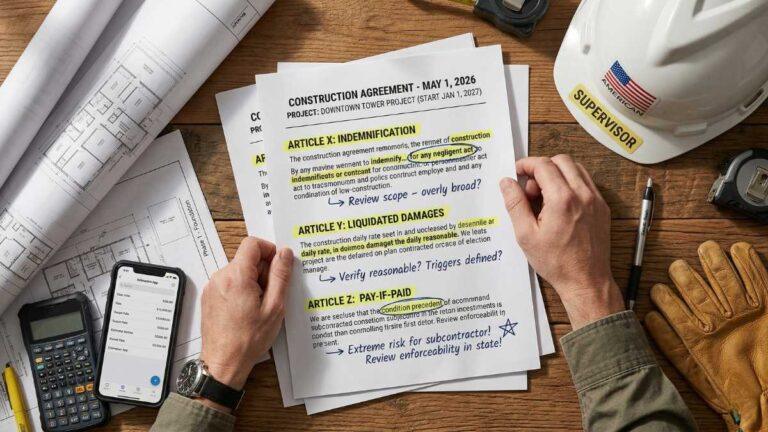
Payment terms in construction contracts is one of the most important elements in any construction contract is the structure of the payment terms. While contractors often focus heavily on scope of work, drawings, specifications, and project timelines, the payment structure quietly determines the financial stability of the entire project. A well-written contract may define exactly what must be built, but if the payment terms are poorly designed, the contractor may still face cash-flow stress, delayed payments, or even project losses despite performing the work correctly.
In the United States construction industry, the two most common payment structures are lump sum contracts and progress payment contracts. Each approach reflects a different philosophy about how project risk, cash flow, and financial control should be distributed between the owner and the contractor. Choosing the wrong payment structure can expose contractors to significant financial pressure, particularly when projects experience delays, material cost fluctuations, or unexpected scope adjustments.
Contractors who understand the mechanics of payment structures are in a far stronger position when negotiating contracts. Payment terms determine when money enters the company, how project expenses must be financed, and how disputes about work completion will be evaluated. In many cases, the success or failure of a construction company’s financial performance on a project is less about the bid price itself and more about how the payment schedule interacts with the contractor’s operating costs and project execution strategy.
Why payment structures matter in construction contracts
Construction projects are capital-intensive operations. Contractors must pay for labor, materials, equipment, insurance, permits, subcontractors, and operational overhead long before final project payment is received. Unlike many industries where payment occurs immediately after product delivery, construction companies often carry large financial burdens during project execution.
If payment structures do not match the financial rhythm of the project, contractors can find themselves financing the job with their own cash reserves or lines of credit. Even profitable projects can become financially stressful if payment milestones are delayed or structured in ways that push contractor expenses ahead of revenue.
Payment terms also influence project transparency. When payment schedules are tied to specific construction milestones, both the owner and contractor gain a shared framework for evaluating progress. Without clear payment triggers, disagreements can arise over whether work has been sufficiently completed to justify invoicing.
Ultimately, the structure of payment terms determines three key elements of a project’s financial dynamics:?
Lump sum contracts and their financial implications
A lump sum contract, sometimes called a fixed-price contract, establishes a single total price for the entire construction project. Under this model, the contractor agrees to complete all specified work for a predetermined amount regardless of the actual costs incurred during execution.
At first glance, lump sum agreements appear straightforward. The owner knows the exact price of the project, and the contractor receives a clear contract value for delivering the finished work. However, this apparent simplicity masks several important financial dynamics.
Under lump sum contracts, contractors assume significant responsibility for cost management. If labor costs increase, materials become more expensive, or productivity decreases due to unforeseen challenges, those expenses are typically absorbed by the contractor unless the contract specifically allows for adjustments. As a result, lump sum agreements require accurate estimating, disciplined project management, and careful risk evaluation before the contract is signed.
Another important feature of lump sum contracts is that they often include milestone payments tied to major stages of project completion. For example, payment installments may be triggered when the foundation is complete, when structural framing is finished, or when mechanical systems are installed. While these milestones provide financial checkpoints, they also create potential areas of disagreement if the owner disputes whether a stage has been fully completed.
For contractors, the main advantage of lump sum contracts is the possibility of achieving higher profit margins when the project is executed efficiently. If costs are controlled effectively and productivity remains strong, the contractor retains the difference between actual expenses and the fixed contract value. However, the downside is equally significant: any cost overruns may directly reduce or eliminate project profit.
Builder Inteligence


Progress payment contracts and staged project financing
Unlike lump sum contracts, progress payment structures distribute payments throughout the construction process based on verified project progress. Rather than receiving payment only at predefined milestones or project completion, contractors invoice regularly for work performed during a specific period.
Progress payments are commonly used in larger commercial, institutional, and public construction projects because they provide a structured approach to financing the work as it unfolds. Contractors typically submit periodic invoices—often monthly—documenting completed work, installed materials, and project progress percentages.
One major advantage of progress payment systems is improved cash flow. Because payments are received more frequently, contractors are able to recover project expenses more quickly and reduce the amount of working capital required to sustain operations. This can be especially important in projects with high material costs or large subcontractor participation.
However, progress payment systems also require careful documentation and verification. Owners and project managers typically review submitted invoices to confirm that the claimed progress accurately reflects work completed on site. If discrepancies arise, payment approval may be delayed until the issue is resolved.
How payment structures affect contractor risk
The choice between lump sum and progress payment structures significantly affects how financial risk is distributed across the project team. Lump sum contracts place greater cost risk on the contractor because the total price is fixed regardless of actual expenses. In contrast, progress payment systems often provide more flexibility for adjusting costs as the project evolves.
However, this flexibility does not eliminate risk entirely. Contractors working under progress payment contracts must maintain accurate reporting, comply with documentation requirements, and ensure that invoices reflect verifiable work progress. Failure to do so can delay payment approval and disrupt project financing.
Contractors must also consider how payment timing interacts with procurement schedules. Large equipment purchases, specialized materials, or early subcontractor mobilization may require significant expenditures before progress payments are received. If payment schedules do not account for these costs, the contractor may still experience temporary cash flow pressure despite using a progress payment structure.
Negotiating payment terms effectively
Experienced contractors understand that payment terms are negotiable components of the construction contract. While owners may propose a standard payment structure, contractors can often negotiate adjustments that improve financial stability without compromising the owner’s interests.
• establishing clear approval timelines for invoices.
Contractors should also ensure that payment terms are consistent with applicable state laws governing construction payments. Many states enforce prompt payment statutes designed to ensure that contractors and subcontractors receive compensation within reasonable timeframes after invoicing.
Why contractors must understand payment mechanics
Payment structures are not merely accounting details; they are strategic mechanisms that shape the financial health of construction companies. Contractors who overlook payment terms may discover that a seemingly profitable project becomes financially difficult to sustain due to delayed cash flow or unfavorable risk allocation.
By contrast, contractors who carefully analyze payment structures before signing contracts gain greater control over project financing, protect their working capital, and reduce the likelihood of payment disputes.
In an industry where project margins are often tight and operational risks are constant, mastering the mechanics of construction payment terms is one of the most important skills a contractor can develop.
More from Builder Inteligence
Advertising

Frequently Asked Questions
1. What is the difference between progress payments and lump sum contracts?
The main difference between progress payments and lump sum contracts lies in how compensation is distributed throughout the project. Lump sum contracts establish a fixed total price for the entire project, while progress payment systems distribute payments periodically based on verified construction progress. This difference significantly affects contractor cash flow and financial risk.
2. Why are progress payments common in large construction projects?
Progress payments are common in large construction projects because they align payment with actual project progress. This structure reduces financial pressure on contractors by allowing them to recover costs throughout the construction process rather than waiting until project completion to receive compensation.
3. What is retainage in construction payment structures?
Retainage is a portion of payment withheld by the owner until the project reaches substantial or final completion. It serves as a financial incentive for contractors to complete the work properly and resolve any outstanding issues before receiving full compensation.
4. How do payment disputes occur in construction contracts?
Payment disputes typically occur when parties disagree about the completion status of work, the validity of submitted invoices, or the interpretation of contract payment clauses. Clear documentation and well-defined payment triggers reduce the likelihood of these disputes.
5. Can contractors negotiate payment terms before signing a contract?
Yes. Payment terms are often negotiable before a contract is finalized. Contractors can request adjustments to payment schedules, retainage percentages, and invoice approval timelines to better align the payment structure with project expenses.
6. Why is cash flow management important for contractors?
Construction companies must pay labor, materials, and subcontractors long before final project payment is received. Effective cash flow management ensures that contractors can sustain operations throughout the project without excessive reliance on external financing.
7. Are payment structures regulated by state laws?
Many states in the United States have prompt payment laws that regulate how quickly contractors and subcontractors must be paid after submitting invoices. These laws help protect contractors from unreasonable payment delays.
8. What should contractors review in payment clauses before signing a contract?
Contractors should carefully review payment schedules, retainage provisions, invoice approval procedures, dispute resolution mechanisms, and conditions for payment release. These clauses determine how and when the contractor will be compensated during the project.