Data center construction is no longer a niche segment inside nonresidential markets. In 2026, it has become one of the most powerful forces reshaping project pipelines, capital allocation, labor competition, and contractor selection across the United States. What makes data centers different is not only their size or technical complexity, but the way they compress decision-making timelines while simultaneously raising the bar for qualification and risk tolerance.
Unlike traditional commercial projects, data centers are driven by long-term digital infrastructure demand rather than local market cycles. Cloud computing, artificial intelligence, enterprise data storage, streaming services, and national security systems all depend on physical facilities that must be built, expanded, and upgraded continuously. This creates a steady, non-discretionary demand stream that behaves very differently from office, retail, or hospitality construction.
For contractors, this shift is quietly restructuring nonresidential pipelines. Firms that understand how data center demand operates are seeing stronger backlog visibility, while others experience thinning pipelines without fully understanding why opportunities are bypassing them.
Why data centers attract capital even when other sectors stall
Data centers attract capital because they are viewed as infrastructure rather than speculative real estate. Investors, private equity groups, and institutional funds see them as essential assets with predictable long-term usage. Even when interest rates remain elevated, capital continues to flow toward data centers because the underlying demand is tied to digital consumption, not discretionary spending.
This capital preference reshapes pipelines by redirecting financing away from traditional nonresidential categories. Office developments may pause, mixed-use projects may delay, but data center projects continue moving through planning and preconstruction. This creates an uneven pipeline landscape where some contractors experience sudden demand spikes while others see prolonged gaps.
The result is not a slowdown in nonresidential construction overall, but a reallocation of opportunity. Contractors aligned with data center work see continuity. Those dependent on legacy commercial sectors feel volatility increase even when total construction spend remains strong.
How data center projects change contractor qualification standards
Data center projects impose qualification standards that go beyond price competitiveness. Owners and developers prioritize operational maturity, documented processes, safety performance, schedule control, and digital coordination capability. Contractors are evaluated long before bid day through online presence, past project documentation, and perceived organizational stability.
This shifts pipelines toward firms that look prepared for complexity. Contractors without clear positioning, strong digital visibility, or structured operations often never receive invitations to compete. The pipeline reshapes silently, not through formal exclusions but through early-stage filtering based on credibility signals.
As a result, pipeline access increasingly depends on how a contractor presents itself across websites, content, certifications, and project communication. Data center demand does not simply increase volume. It raises the threshold for entry.


Labor and scheduling pressure created by data center demand
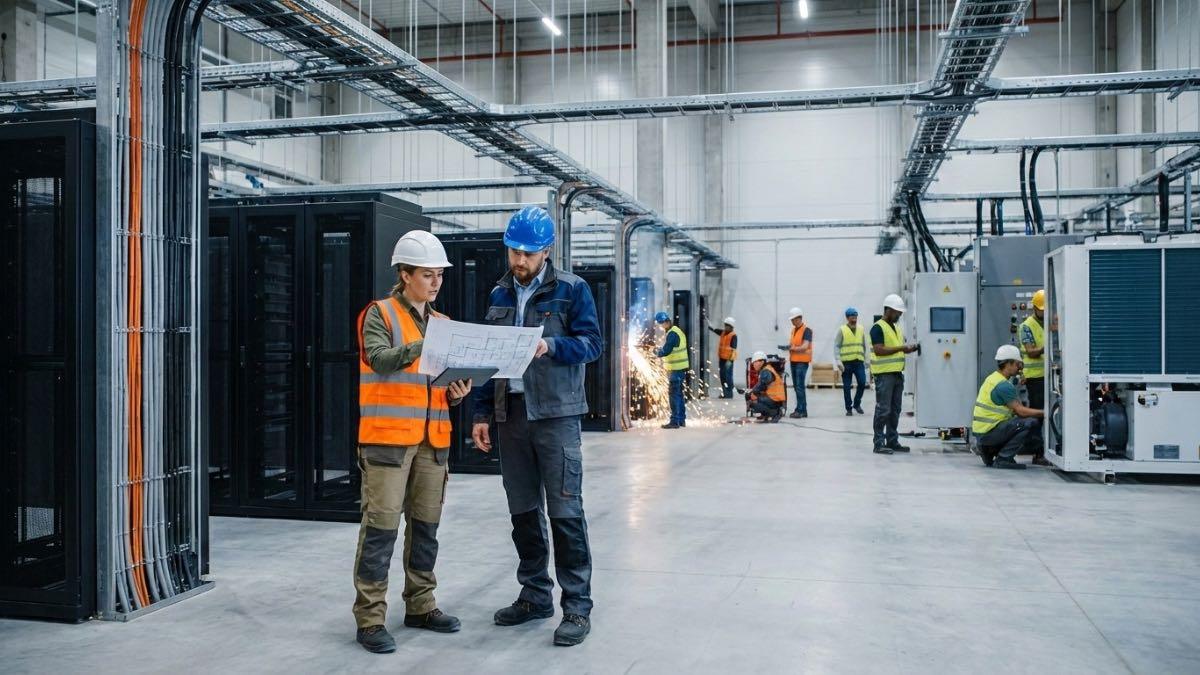
Data centers absorb skilled labor aggressively. Electrical, mechanical, HVAC, low-voltage, and specialized trades are pulled into long-duration, high-intensity projects. This labor draw reduces availability for other nonresidential sectors, indirectly increasing costs and schedule risk across the broader market.
Contractors competing outside data centers face tighter labor markets and higher wage pressure even if they are not bidding digital infrastructure work directly. Scheduling assumptions that worked in prior years fail under these conditions, forcing contractors to reprice risk and extend timelines.
In this way, data centers reshape pipelines beyond their own projects. They alter labor economics regionally, influence subcontractor availability, and push scheduling certainty to the forefront of owner decision-making across all nonresidential construction.
Regional concentration amplifies pipeline imbalance
Data center development is highly concentrated geographically. Northern Virginia, Texas, Arizona, Ohio, Georgia, North Carolina, and parts of the Midwest dominate planning activity due to power availability, land scale, regulatory alignment, and network proximity. Contractors operating in or near these regions experience disproportionate exposure to data center-driven demand.
This concentration intensifies regional competition. Firms within these markets face higher opportunity density but also stronger qualification pressure. Firms outside these zones may see pipelines soften even if national construction headlines remain positive.
Understanding where data centers are clustering is now essential to forecasting pipeline health. National averages obscure the regional reality contractors actually operate inside.
Why pipelines look “full” but behave differently
Many contractors report pipelines that appear full on paper but convert differently than before. Data center-driven pipelines move faster, cancel less frequently, but demand higher upfront commitment in preconstruction resources, coordination, and compliance.
This creates a misleading sense of abundance. Contractors who overextend chasing data center work without meeting qualification expectations burn estimating resources with low conversion rates. Others misinterpret strong planning activity as guaranteed starts, leading to forecasting errors.
Data centers reshape not only what fills pipelines, but how those pipelines behave under pressure.
What contractors must do to align with this shift
Contractors who want to benefit from data center-driven pipelines must invest in operational clarity, digital presence, and risk communication. This includes stronger preconstruction capabilities, transparent scheduling frameworks, documented safety systems, and credible online positioning.
Data center demand rewards preparedness, not opportunism. Firms that align early see more stable backlog and pricing power. Those that wait experience pipeline erosion without obvious warning signs.
In 2026, understanding data centers is no longer optional for nonresidential contractors. It is foundational to pipeline strategy.
More from Builder Inteligence



FAQ – How data centers are reshaping nonresidential pipelines
1 – Why are data centers reshaping nonresidential construction pipelines?
Data centers create consistent, long-term demand tied to digital infrastructure rather than discretionary spending, redirecting capital, labor, and contractor selection toward projects viewed as essential assets.
1. How do data center projects affect contractor qualification?
Owners evaluate contractors based on operational maturity, safety records, digital coordination capability, and credibility long before bids, filtering pipelines early and silently.
2. Why do pipelines look full but convert differently?
Data center-driven pipelines require more upfront commitment and qualification, causing lower conversion rates for unprepared contractors despite strong planning activity.
3. Which regions benefit most from data center construction?
Northern Virginia, Texas, Arizona, Ohio, Georgia, North Carolina, and parts of the Midwest dominate due to power infrastructure, land availability, and network proximity.
4. How do data centers impact labor markets?
They absorb skilled labor aggressively, increasing wage pressure and reducing availability for other nonresidential sectors regionally.
5. Do data centers increase overall construction demand?
They reallocate demand more than they increase totals, shifting opportunity toward contractors aligned with complexity and infrastructure-scale work.
6. Why is digital presence critical for pipeline access?
Data center owners research contractors early. Weak digital visibility or unclear positioning eliminates firms before formal procurement begins.
7. What is the biggest mistake contractors make with data center pipelines?
Assuming planning equals starts and chasing opportunities without meeting qualification standards, leading to wasted estimating effort and forecasting errors.