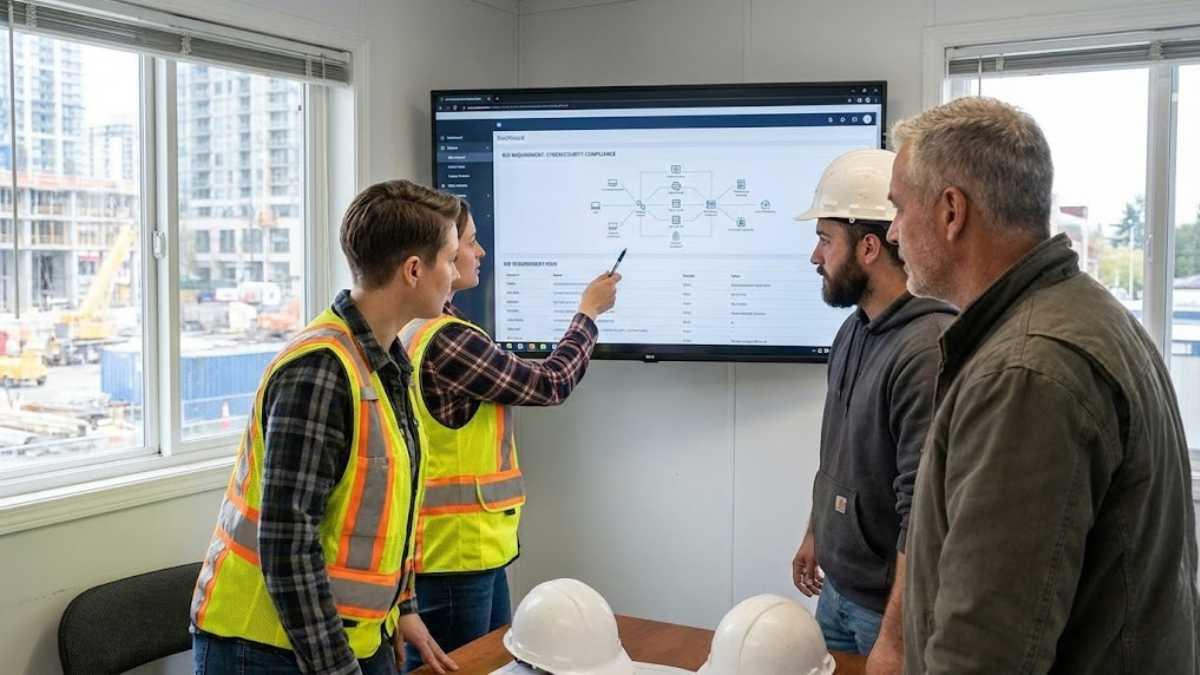
Cybersecurity has quietly moved from an IT concern to an operational and contractual issue in the United States construction market. In 2026, it is no longer treated as an internal back-office decision, but as a visible risk factor that owners, lenders, insurers, and public agencies actively evaluate before awarding contracts. What was once optional or informal is now directly tied to eligibility, pricing, and even project continuity.
Construction firms manage an expanding volume of sensitive data. Project schedules, cost breakdowns, payroll records, subcontractor agreements, BIM files, RFIs, change orders, and digital closeout documentation now flow through cloud platforms, mobile devices, and third-party software ecosystems. Each connection expands the attack surface. As construction becomes more digital, it also becomes more exposed. Cyber incidents no longer disrupt only office operations. They can halt jobsites, delay payments, freeze procurement, and trigger contractual disputes.
The shift in perception is driven by real losses. Ransomware attacks, data breaches, invoice fraud, and system lockouts have already caused multi-million-dollar disruptions across U.S. construction firms. In response, owners and financiers increasingly treat cybersecurity posture as a proxy for operational maturity. In 2026, weak cybersecurity signals weak controls, poor risk management, and elevated project exposure.
Why owners now evaluate cybersecurity before awarding work
Owners are no longer asking about cybersecurity out of curiosity. They are responding to direct financial and operational risk. A contractor’s cyber incident can expose owner data, disrupt schedules, compromise safety systems, and delay closeout documentation. For large projects, the financial consequences extend well beyond the contractor’s balance sheet.
In public sector and institutional construction, cybersecurity requirements are increasingly formalized. Requests for proposals now include language around data protection, access control, incident response plans, and compliance with specific security standards. Contractors that cannot demonstrate baseline controls are filtered out early, regardless of price or technical capability.
Private owners are following the same path. Developers, healthcare operators, industrial clients, and technology-driven owners increasingly require assurance that digital project data will be protected throughout the lifecycle. In competitive bids, cybersecurity is no longer a differentiator. It is a threshold requirement. Failing it means the proposal is never seriously evaluated.


How construction cyber risk differs from other industries
Cybersecurity in construction presents unique challenges that generic IT frameworks often fail to address. Construction environments are decentralized, mobile, and heavily reliant on third parties. Jobsites use tablets, smartphones, drones, cameras, and connected equipment that often bypass traditional corporate networks. Subcontractors, vendors, and consultants access shared platforms with varying levels of security discipline.
This fragmentation creates systemic risk. A single compromised subcontractor login can expose an entire project ecosystem. Phishing attacks targeting accounting teams can redirect payments. Compromised project management platforms can alter schedules, RFIs, or inspection records. In 2026, these risks are no longer hypothetical. They are active threat vectors documented across the industry.
Additionally, construction firms often operate with thin IT staffing and limited cybersecurity expertise. This gap makes them attractive targets. Attackers understand that operational pressure, tight deadlines, and distributed teams reduce detection speed. Cybersecurity failures in construction are rarely about sophisticated breaches. They are usually about basic controls not being enforced consistently.
Cybersecurity as an insurance and financing fator
Insurance carriers have significantly tightened underwriting standards for cyber coverage in construction. Premiums rise sharply for firms without documented controls, multi-factor authentication, backup protocols, and incident response planning. In some cases, coverage is denied entirely. Cyber insurance is no longer a safety net for poor practices. It is a validation mechanism for disciplined operations.
Lenders and bonding companies are also paying attention. A cyber incident that disrupts cash flow, delays progress billing, or freezes financial systems directly impacts project viability. In 2026, financiers increasingly assess cybersecurity readiness as part of overall risk evaluation, particularly for large or long-duration projects.
For contractors, this creates a cascading effect. Weak cybersecurity increases insurance costs, reduces bonding capacity, and raises financing friction. Strong cybersecurity, by contrast, stabilizes operational risk and preserves access to capital. In competitive markets, this difference influences which firms can pursue larger, more complex work.
What construction firms must control to remain competitive
Effective cybersecurity in construction is not about expensive tools. It is about disciplined controls. Identity management, access permissions, device security, backup integrity, vendor access governance, and incident response readiness form the foundation. Contractors must know who accesses what, from where, and under which conditions.
Training is equally critical. Most construction cyber incidents originate from human error rather than system failure. Phishing awareness, payment verification protocols, and device usage policies reduce exposure dramatically. In 2026, firms that treat cybersecurity training as operational training outperform those that delegate it to IT alone.
Finally, cybersecurity must be embedded into project workflows. Access should be provisioned per project, revoked promptly at closeout, and monitored continuously. Contractors who integrate cybersecurity into their operational systems reduce risk without slowing delivery. Those who ignore it increasingly find themselves excluded from serious bids.
Cybersecurity as a signal of operational maturity
In 2026, cybersecurity functions as a visible signal. It tells owners, insurers, and partners how a contractor manages risk, controls processes, and protects continuity. Firms that invest early position themselves as reliable, scalable, and contract-ready. Those that delay face shrinking opportunity sets.
Cybersecurity is no longer an abstract threat. It is a concrete operational requirement shaping who wins work, who qualifies for insurance, and who remains trusted in an increasingly digital construction environment. In this context, cybersecurity is not about technology. It is about credibility.
Advertising


FAQ – Cybersecurity in construction firms
1. Why is cybersecurity becoming a bid requirement in construction?
Cybersecurity is becoming a bid requirement because owners and lenders recognize that digital disruptions can halt projects, expose sensitive data, and create contractual risk. In 2026, cybersecurity posture is used as an indicator of operational control and risk management maturity, not just IT capability.
2. What types of cyber threats most affect construction companies?
Construction companies are most affected by phishing attacks, ransomware, invoice fraud, credential theft, and platform access breaches. These threats exploit decentralized teams, third-party access, and time-sensitive financial processes common across construction operations.
3. How does cybersecurity impact construction insurance costs?
Insurance carriers now assess cybersecurity controls before issuing or renewing cyber coverage. Firms without multi-factor authentication, secure backups, and documented response plans face higher premiums or denial of coverage, directly increasing operational cost and financial exposure.
4. Do small and mid-size contractors face the same cyber risk?
Yes. Smaller contractors are often more vulnerable due to limited IT resources and informal processes. Attackers target them because defenses are weaker, not because project size is smaller. In 2026, size does not reduce cyber exposure.
5. What cybersecurity controls matter most for construction firms?
Identity access management, multi-factor authentication, secure backups, controlled vendor access, payment verification procedures, and employee training are the most impactful controls. These measures address the most common failure points without requiring excessive complexity.
6. Can poor cybersecurity disqualify a contractor from a project?
Yes. Many RFPs now include cybersecurity requirements. Contractors unable to demonstrate baseline protections are filtered out early. In competitive bids, failing cybersecurity criteria often eliminates proposals regardless of price or technical qualifications.
7. How should contractors integrate cybersecurity into operations?
Cybersecurity should be embedded into project workflows, not isolated within IT. Access should be granted per project, monitored continuously, and revoked promptly. Training should align with operational roles, ensuring security supports delivery rather than obstructing it.