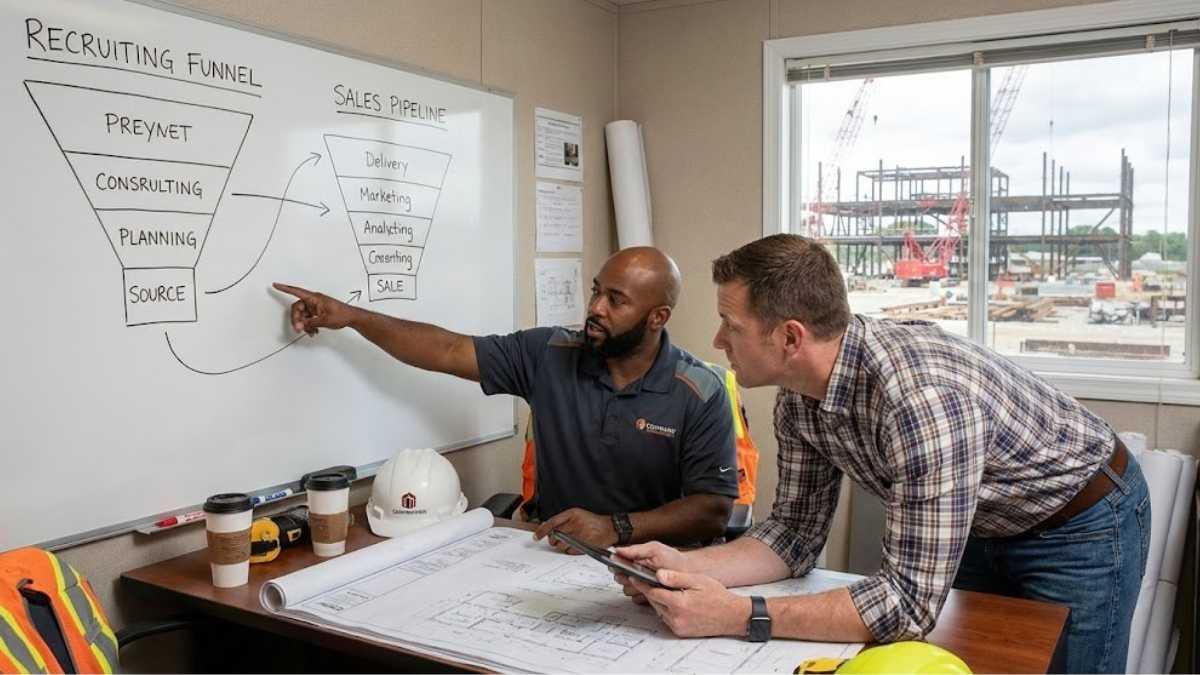
In construction, hiring failures rarely happen because there are no workers available. They happen because companies treat recruiting as an isolated activity instead of a system. In 2026, contractors who continue to post jobs and wait are consistently outperformed by those who design recruiting the same way they design sales. A structured recruiting funnel does not depend on luck. It creates predictable inflow, filters candidates early, and converts the right workers consistently.
A recruiting funnel mirrors a sales pipeline because both rely on visibility, trust, qualification, and follow-up. Just as clients move from awareness to decision, workers move from discovery to commitment. Contractors who understand this stop chasing labor and start attracting it with intent and control.

Why random hiring efforts fail under labor pressure
Most contractors still hire reactively. A project ramps up, labor is needed immediately, and job ads go live overnight. This approach creates urgency but not quality. It attracts anyone available, not necessarily anyone aligned. Over time, this increases turnover, onboarding costs, and rework on jobsites.
Without a funnel, there is no filtering. Workers apply without understanding expectations, culture, or workload. Misalignment is discovered only after hiring, when it is already expensive. A recruiting funnel shifts filtering forward, reducing friction later.
Labor pressure in the United States has made this gap more visible. When competition for skilled trades increases, companies without a structured recruiting system are forced to accept whoever responds first instead of who fits best.
Awareness stage: how workers discover your company
Every recruiting funnel starts with awareness. If workers do not know your company exists, nothing else matters. In 2026, awareness is driven almost entirely by digital visibility. Local SEO, Google Business profiles, project content, and employer branding determine whether workers ever consider applying.
At this stage, the goal is not hiring. It is positioning. Workers should immediately understand what type of contractor you are, what kind of work you do, and where you operate. Confusion at this stage eliminates interest instantly.
Strong awareness content answers silent questions. Is this company stable. Do they run organized jobsites. Are projects consistent. Do crews stay long term. Marketing assets must communicate these signals clearly before any application is submitted.

Consideration stage: pre-qualifying before applications
In a sales pipeline, not every lead becomes a prospect. The same principle applies to recruiting. The consideration stage exists to discourage the wrong candidates while encouraging the right ones. This is where most contractors fail.
Detailed job descriptions, realistic project explanations, and clear expectations reduce unqualified applications. While this may lower volume, it dramatically improves quality. A recruiting funnel is designed to filter early, not late.
Content such as crew testimonials, jobsite walkthroughs, and leadership explanations helps workers self-select. Candidates who continue through this stage arrive informed and committed, reducing drop-off and early exits.
Conversion stage: turning interest into commitment
Conversion happens when a qualified worker decides to apply and engage. At this point, speed and clarity matter. Complicated application processes, slow responses, or unclear next steps cause drop-off even among strong candidates.
Just like sales follow-up, recruiting follow-up must be consistent and fast. Delays signal disorganization. Clear timelines and communication increase trust and close the loop effectively.
Contractors who treat recruiting like sales understand that responsiveness is a competitive advantage. Workers compare experiences just as clients do.
Why recruiting funnels reduce turnover and cost
A structured recruiting funnel does not just fill positions. It improves retention. Workers who enter through a clear, transparent funnel are less likely to quit because expectations were aligned from the start.
This reduces the true cost of hiring, which includes training, productivity loss, and crew disruption. Contractors who invest in recruiting infrastructure stabilize their workforce instead of cycling through replacements.
In 2026, stability is a competitive edge. Recruiting funnels transform hiring from a reactive expense into a controlled system.


FAQ – How to build a recruiting funnel that works like a sales pipeline
1. What is a recruiting funnel in construction?
A recruiting funnel is a structured system that guides workers from awareness to application to hiring, filtering candidates early and improving fit, retention, and hiring predictability across construction companies.
2. Why should recruiting work like a sales pipeline?
Because both rely on visibility, qualification, trust, and follow-up. Workers evaluate employers similarly to how clients evaluate contractors, making pipeline logic effective for hiring.
3. Does a recruiting funnel reduce applicant volume?
Yes, intentionally. It reduces low-quality applications while increasing alignment, saving time, reducing turnover, and improving long-term workforce stability.
4. What role does marketing play in recruiting funnels?
Marketing drives awareness and positioning. Without strong marketing, the funnel has no entry point, leaving HR to process too few or poorly matched candidates.
5. Is this approach only for large contractors?
No. Small and mid-sized contractors benefit the most because structured funnels reduce chaos, lower hiring costs, and improve retention without large HR teams.
6. How does local SEO impact recruiting funnels?
Local SEO ensures workers searching for jobs in specific regions find
your company, feeding the top of the funnel consistently and predictably.
7. What is the biggest mistake when building a recruiting funnel?
Overcomplicating it. The goal is clarity and consistency, not complexity. Simple systems executed well outperform complex systems ignored.
8. How fast should contractors respond to applicants?
Ideally within 24 hours. Slow responses signal disorganization and push qualified candidates toward competitors with faster communication.