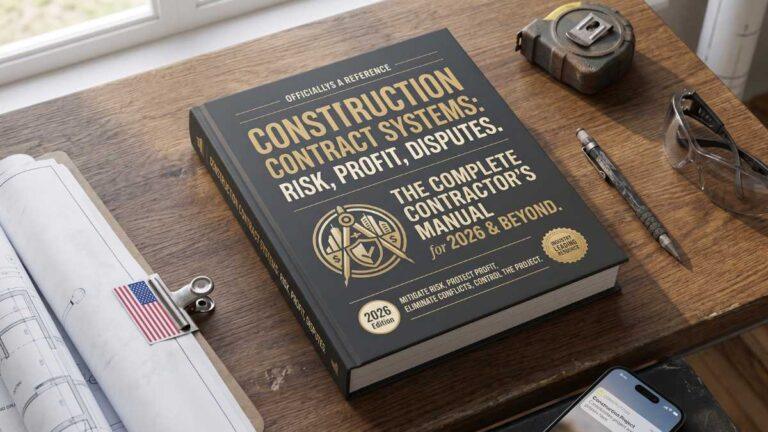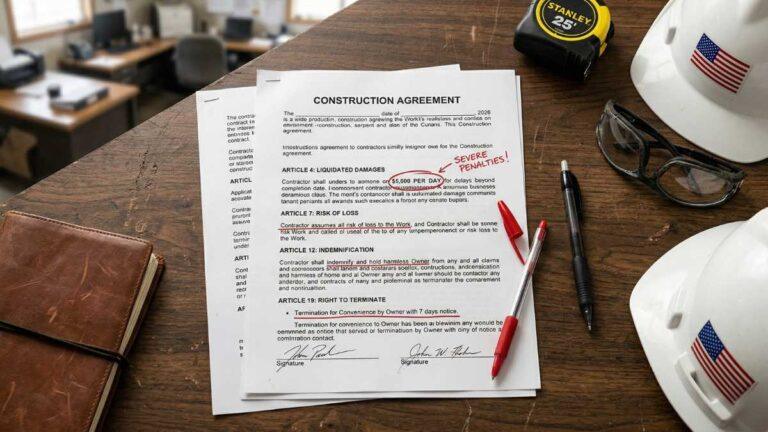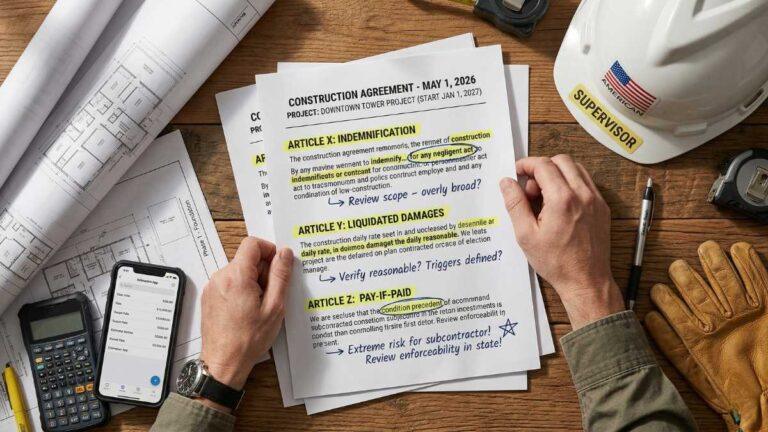
The complete construction contract system in the United States: contracts are often treated as a necessary formality — something to be signed, filed, and referenced only when problems arise. In 2026, this mindset is one of the most expensive mistakes a contractor can make. Contracts are not passive documents. They are active control systems that determine how money flows, how risk is distributed, and how disputes are resolved long before the first issue appears.
Most contractors focus heavily on estimating, scheduling, and execution, believing these are the primary drivers of success. While these elements are critical, they operate within boundaries defined by the contract. If those boundaries are weak, unclear, or unbalanced, even a well-executed project can result in financial loss, delayed payments, or legal exposure.
The construction contract is where profit is either protected or silently lost. It defines scope, establishes expectations, governs changes, and determines how conflicts will be handled. Yet, many contractors rely on generic templates, outdated agreements, or verbal understandings that fail under pressure.
The reality is simple:
You don’t lose money when the problem happens.
You lose money when the contract fails to protect you before it happens.
What a construction contract really controls
A construction contract is not just a legal agreement. It is a financial and operational framework that controls how a project behaves. It defines not only what work will be performed, but also how that work is measured, billed, modified, and enforced.
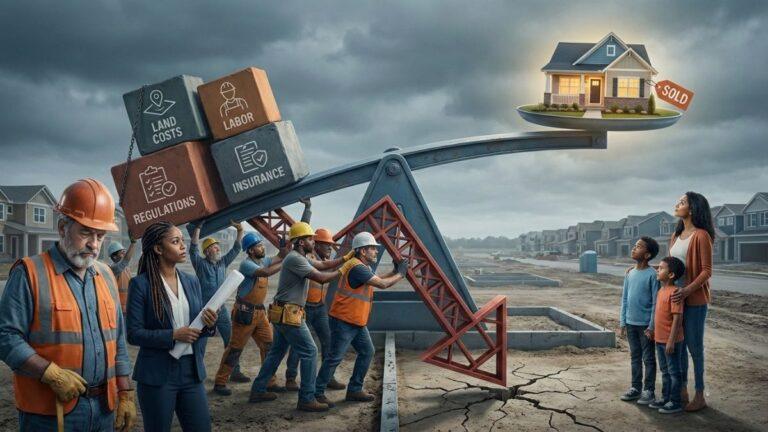
At its core, a contract governs three critical dimensions: scope, money, and risk. Scope defines what is included and excluded. Money defines how and when payments are made. Risk defines who is responsible when things do not go as planned.
In the U.S., many standard contract structures are influenced by organizations such as the American Institute of Architects, which provide widely used templates. However, these templates are only effective when properly customized and understood. Contractors who use them without adaptation often inherit risks they do not fully recognize.
A strong contract creates clarity before execution begins. It removes ambiguity, aligns expectations, and establishes enforceable mechanisms for handling changes and disputes.
A weak contract does the opposite.
It creates confusion that only becomes visible when it is too late.
Why most contractors lose money through contracts
The majority of contractors do not intentionally ignore contract strategy. The issue is that contracts are often treated as administrative tasks rather than strategic tools. They are reviewed quickly, signed under time pressure, and rarely analyzed in terms of long-term impact.
One of the most common problems is unclear scope definition. When the contract does not explicitly define what is included, contractors end up performing additional work without compensation. Clients may assume certain elements are part of the agreement, while contractors consider them extras. Without clarity, disputes are inevitable.
Another major issue is payment structure. Contracts that allow delayed payments, excessive retainage, or vague billing conditions create cash flow problems that can destabilize a business. Contractors often accept these terms to secure the project, underestimating their impact during execution.
Risk allocation is another critical factor. Many contracts transfer disproportionate risk to the contractor, including unforeseen conditions, design errors, or delays caused by others. Without proper review, contractors assume liabilities that can result in significant financial loss.
Change order processes are also frequently weak or undefined. When changes occur — and they always do — the lack of a structured process leads to informal agreements, delayed pricing, and difficulty in recovering costs.
The pattern is consistent across projects:
The contract is signed quickly.
The consequences unfold slowly.
The hidden financial impact of poor contract structure
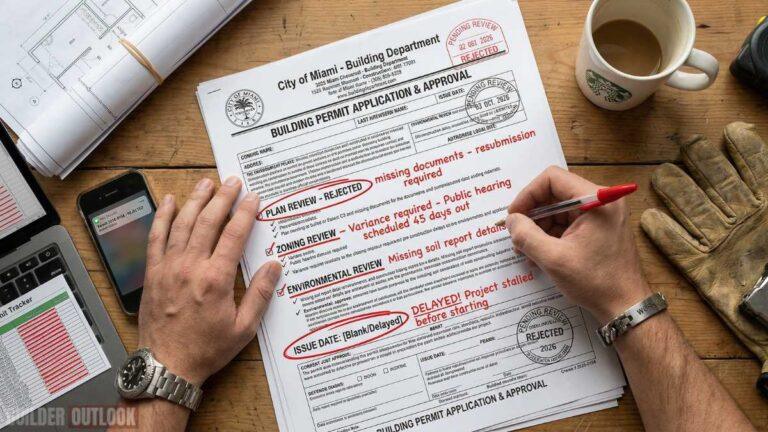
The financial damage caused by weak contracts is rarely immediate. It accumulates over time, often unnoticed until the project is nearing completion. Small scope gaps, underpriced changes, and delayed payments create a gradual erosion of profit.
One of the most significant impacts is unpaid work. Contractors perform additional tasks based on assumptions or verbal agreements, only to face resistance when attempting to bill for them. Without contractual backing, recovery becomes difficult.
Cash flow is also heavily affected. Contracts that allow extended payment cycles or unclear billing requirements delay revenue while expenses continue. This creates financial pressure that can affect multiple projects simultaneously.
Disputes are another major consequence. Ambiguity in the contract leads to disagreements over scope, quality, and responsibility. These disputes consume time, resources, and often result in compromised settlements.
Legal exposure increases as well. Contractors operating under poorly structured contracts are more vulnerable to claims and litigation, especially when responsibilities are not clearly defined.
The most important insight is this:
Contracts do not create problems.
They determine how expensive those problems become.
Builder Inteligence


Core components of a high-performance contract system
To transform contracts into effective control systems, contractors must understand and structure key components intentionally. The first is scope definition. Every element of the project must be clearly described, including inclusions, exclusions, and assumptions. This reduces ambiguity and sets clear expectations.
The second component is payment terms. Contracts must define how and when payments are made, including milestones, billing procedures, and retainage. Clear payment structures improve cash flow and reduce disputes.
The third component is change order procedures. A structured process must be established for documenting, pricing, and approving changes before work begins. This protects revenue and maintains control.
The fourth component is risk allocation. Contracts should clearly define responsibilities for unforeseen conditions, delays, and errors. This ensures that risks are distributed fairly and predictably.
The fifth component is dispute resolution. Mechanisms for resolving conflicts — such as mediation or arbitration — should be defined in advance, reducing uncertainty.
These components are not optional.
They are the foundation of control.
How elite contractors use contracts as profit tools
High-level contractors approach contracts differently. They do not see them as paperwork — they see them as leverage. Every clause is evaluated in terms of its impact on profit, risk, and control.
Before signing, they analyze scope in detail, identifying potential gaps and clarifying them. They negotiate payment terms to align with their cash flow needs, reducing financial pressure during execution.
They implement strict change order processes, ensuring that additional work is always documented and approved before it begins. This prevents revenue leakage and maintains alignment.
They also review risk allocation carefully, avoiding contracts that transfer excessive liability. When necessary, they adjust pricing to compensate for increased risk.
Communication is integrated into the process. Clients are educated about how the contract works, reducing misunderstandings and building trust.
These contractors do not rely on luck.
They rely on structure.
Real example: a contract that protected millions
A commercial contractor in California was negotiating a large project with complex design elements. The initial contract included vague scope definitions and broad risk clauses that transferred responsibility for design inconsistencies to the contractor.
Instead of accepting the contract as presented, the contractor revised key sections. Scope was clarified, responsibilities were redefined, and a structured change order process was implemented.
During execution, design issues emerged that would have resulted in significant additional work. Because the contract clearly defined responsibility, the contractor was able to issue change orders and recover the full cost.
The difference was not in execution.
It was in the contract.
How to build a contract system that actually works
Building a contract system requires more than using templates. It involves creating a structured approach to how contracts are reviewed, negotiated, and managed.
The first step is standardization. Contractors should develop internal templates that reflect their business model and risk tolerance. These templates serve as a baseline for negotiations.
The second step is review. Every contract must be analyzed in detail before signing, focusing on scope, payment terms, risk allocation, and change procedures.
The third step is negotiation. Contractors must be willing to adjust terms to protect their interests, even if it requires difficult conversations.
The fourth step is implementation. Contracts must be actively used during the project, guiding decisions and processes.
The fifth step is training. Teams must understand how contracts work and how to apply them in daily operations.
A contract system is not static.
It evolves with experience.
Your contract is your business model in writing
In 2026, contractors are not losing money because projects are difficult.
They are losing money because their contracts do not protect them.
Those who build strong contract systems control risk, secure revenue, and operate with confidence. Those who rely on generic agreements continue to face disputes, delays, and financial loss.
The contract is not just a document.
It is your business model in writing.
More from Builder Inteligence

Frequently Asked Questions
1. What is a construction contract?
A construction contract is a legally binding agreement that defines scope, payment terms, responsibilities, timelines, and risk allocation between parties. In the United States construction industry, a well-structured contract is the foundation of financial protection, ensuring that contractors maintain control over execution and avoid costly disputes.
2. Why are construction contracts critical for project success?
Construction contracts are critical because they define how every aspect of the project will be executed and paid. Without clear terms, contractors face scope confusion, delayed payments, and legal exposure. In the U.S. market, contract strength directly impacts profitability and long-term business stability.
3. What are the most important clauses in a construction contract?
The most important clauses include scope definition, payment terms, change order procedures, dispute resolution, and scheduling obligations. These elements determine how work is performed and how risks are managed. In U.S. construction, weak clauses often lead to financial losses and project instability.
4. Can a poorly written contract destroy project profitability?
Yes, a poorly written contract can significantly reduce or eliminate project profit. Even when execution is strong, unclear terms can lead to unpaid work, disputes, and delays. In the United States, many contractors lose money due to contract weaknesses rather than operational failures.
5. Should contractors negotiate contract terms before signing?
Yes, contractors should always negotiate contract terms before signing. Accepting unfavorable clauses increases financial and legal exposure. High-level contractors in the U.S. treat contract negotiation as a strategic process, ensuring all risks, payment structures, and responsibilities are clearly defined.
6. How do contracts affect payment security?
Contracts define when, how, and under what conditions payments are made. Without strong payment terms, contractors risk delays or non-payment. In the U.S. construction industry, payment security depends heavily on contract structure and enforcement mechanisms.
7. Can contracts prevent construction disputes?
Contracts cannot eliminate disputes entirely, but they significantly reduce their frequency and impact. Clear scope, defined processes, and structured communication reduce misunderstandings. In the United States, strong contracts are the first line of defense against legal and financial conflict.
8. Should contractors use legal support for contracts?
Yes, legal support is highly recommended when drafting or reviewing construction contracts. Attorneys help identify risk, improve clauses, and ensure compliance. In the U.S., contractors who invest in legal structure early avoid much larger costs during disputes.
Lorem ipsum dolor sit amet, consectetur adipiscing elit. Ut elit tellus, luctus nec ullamcorper mattis, pulvinar dapibus leo.