In the construction contracts in the United States, most contractors believe they understand contracts — until something goes wrong. In 2026, contracts are no longer just formal agreements that define scope and payment. They are complex risk allocation systems designed to protect one party more than the other. And in many cases, contractors sign them without fully understanding how that risk is structured.
The problem is not the existence of unfavorable clauses. The problem is that contractors often focus only on price, scope, and deadlines, ignoring the deeper layers of the contract that control liability, payment conditions, dispute resolution, and risk transfer. These overlooked sections are where profit is lost, responsibilities are shifted, and financial exposure is created.
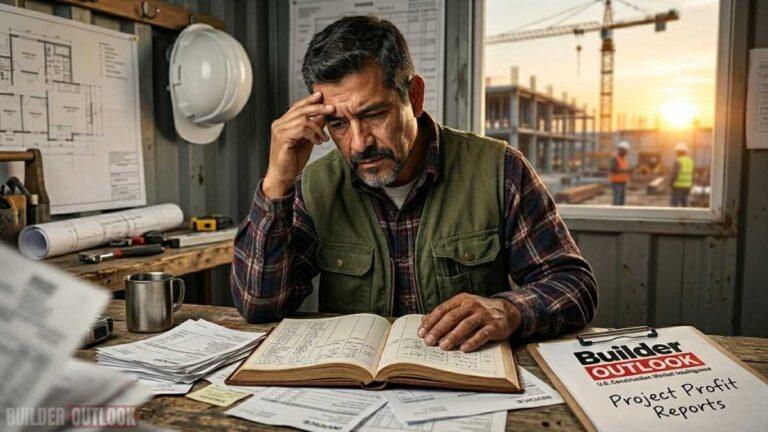
Many contractors only revisit the contract when a problem arises — a delayed payment, a rejected change order, or a dispute over scope. At that point, the contract is no longer a negotiation tool. It is an enforcement mechanism. And if the terms are unfavorable, the contractor is already locked into a position that is difficult, expensive, and sometimes impossible to reverse.
The reality is this:
You don’t lose money on the project.
You lose it in the contract you signed before it started.
WHAT A CONSTRUCTION CONTRACT REALLY CONTROLS
A construction contract is not just a description of the work to be performed. It is a structured framework that defines how risk, responsibility, and money flow throughout the project. It governs not only what is built, but how problems are handled when things deviate from the plan — which they almost always do.
Standardized contract frameworks, such as those developed by the American Institute of Architects, provide balanced structures that outline responsibilities for both parties. However, many real-world contracts are heavily modified or entirely custom, often shifting risk toward the contractor through subtle but powerful clauses.
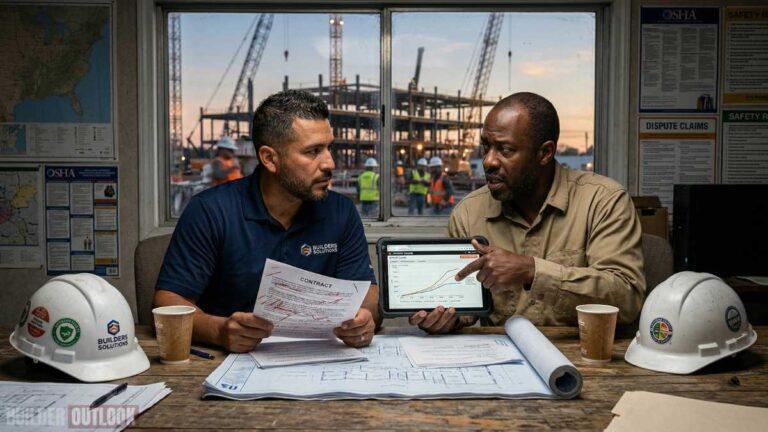
These clauses may define payment conditions, limit liability, impose strict notice requirements, or transfer responsibility for unforeseen conditions. Contractors who do not analyze these elements carefully may unknowingly accept obligations that go far beyond the original scope of work.
A contract does not just define the project.
It defines who absorbs the problem when the project goes wrong.
WHY CONTRACTORS LOSE CONTROL AT THE CONTRACT LEVEL IN 2026
The construction environment in 2026 has increased contractual complexity significantly. Projects involve more stakeholders, more legal oversight, and tighter financial structures. At the same time, competition pressures contractors to sign agreements quickly to secure work, often without thorough review.
One of the main reasons contractors lose control is speed. In the effort to win projects, contracts are signed without proper analysis. Clauses that seem standard are accepted without understanding their implications, especially when they are written in dense legal language.
Another major issue is lack of negotiation. Many contractors assume that contracts are non-negotiable, particularly in larger projects. However, many clauses can be adjusted — if identified early. Once signed, the opportunity to negotiate is gone.
Additionally, contractors often underestimate the importance of legal review. Without professional analysis, subtle risks remain hidden until they are triggered by real project conditions.
This creates a situation where contractors operate under terms they do not fully understand.
And when problems arise, those terms define the outcome.
THE MOST DANGEROUS CLAUSES
CONTRACTORS IGNORE
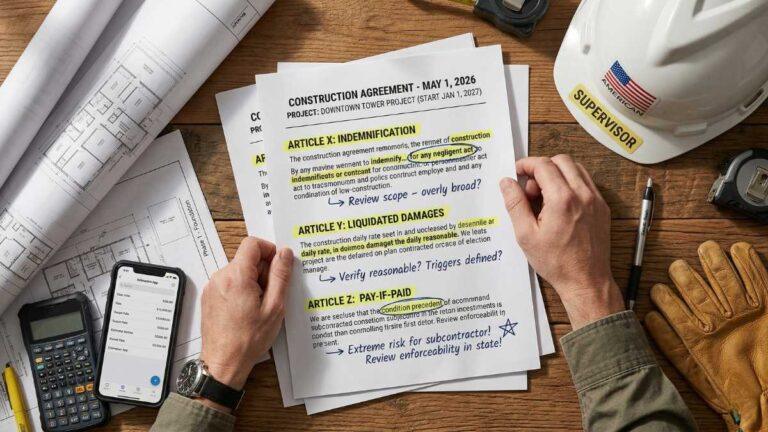
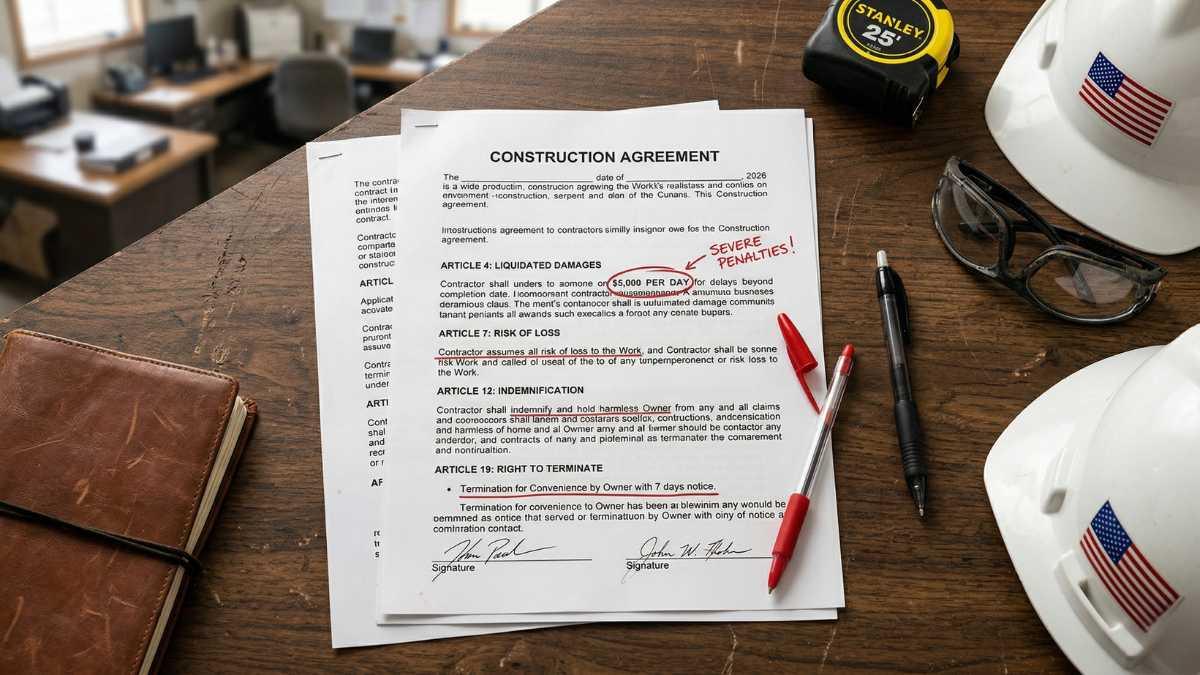
Certain contract clauses consistently create financial and operational risk for contractors. One of the most critical is the “pay-if-paid” or “pay-when-paid” clause, which ties the contractor’s payment to the owner’s payment to the general contractor. This shifts financial risk downstream, potentially delaying or preventing payment entirely.
Another high-risk clause is the notice requirement. Many contracts require contractors to notify the client of issues, delays, or changes within a very short timeframe. Failure to comply can result in loss of the right to claim additional time or compensation, even if the claim is valid.
Indemnification clauses are also significant. These can require contractors to assume liability for damages, sometimes beyond their direct control. Without careful review, contractors may accept disproportionate legal exposure.
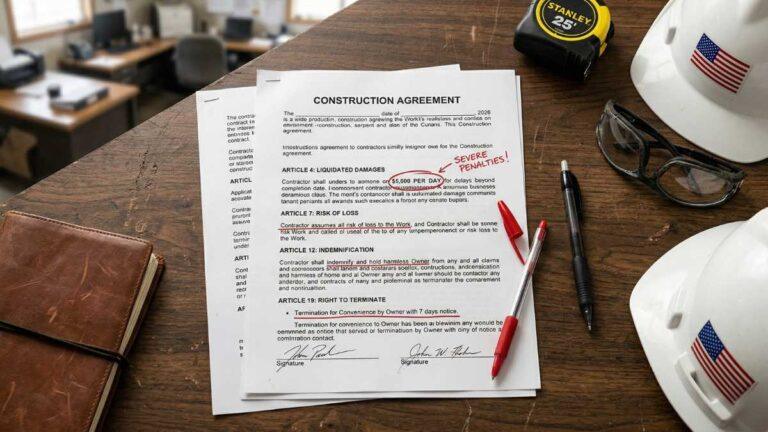
Liquidated damages clauses define penalties for delays, often without considering the complexity of real-world conditions. These penalties can accumulate quickly, turning minor delays into major financial losses.
Finally, scope definition clauses can create ambiguity. If the scope is not clearly defined, contractors may be expected to perform additional work without compensation.
These clauses are not always obvious.
But they are always active.
Builder Inteligence
Advertising

HOW CONTRACT TERMS DIRECTLY IMPACT PROFIT AND CASH FLOW
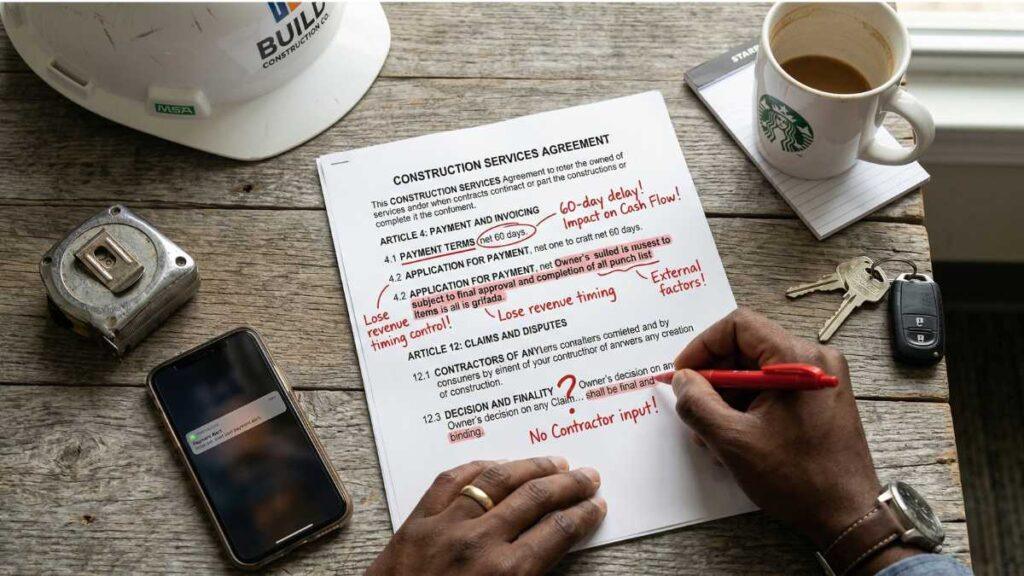
Contract terms are not abstract legal concepts. They have direct operational and financial consequences. Payment terms determine when and how money is received, affecting cash flow stability. If payment conditions are tied to external factors, contractors lose control over their revenue timing.
Change order clauses define how additional work is approved and compensated. If these clauses are restrictive or unclear, contractors may struggle to recover costs for legitimate changes.
Scheduling clauses can impose strict deadlines without accounting for external delays, increasing the risk of penalties. At the same time, notice requirements can limit the contractor’s ability to claim extensions or additional compensation.
Dispute resolution clauses determine how conflicts are handled, including whether disputes go to mediation, arbitration, or litigation. These processes can be time-consuming and expensive, impacting both finances and operations.
Every clause has a consequence.
And those consequences are not theoretical.
HOW HIGH-LEVEL CONTRACTORS PROTECT THEMSELVES BEFORE SIGNING
Contractors who operate at a high level do not treat contracts as formalities. They treat them as strategic documents that require careful analysis and negotiation. This process begins before signing, not after problems arise.
The first step is detailed review. Every clause is analyzed to identify potential risks, especially those related to payment, liability, and scheduling.
The second step is negotiation. Contractors actively request adjustments to unfavorable terms, even in competitive environments. Small changes in wording can significantly reduce risk.
The third step is legal support. Working with construction attorneys ensures that contracts are interpreted correctly and risks are identified early.
The fourth step is internal alignment. Project managers and teams understand the contract terms, ensuring that operations comply with requirements such as notice periods and documentation.
The fifth step is risk assessment. Contractors evaluate whether the project is worth the contractual exposure. In some cases, the best decision is to walk away.
This approach shifts the contractor from reactive to strategic.
REAL EXAMPLE: PROFIT LOST BEFORE THE PROJECT STARTED
A contractor in Illinois signed a commercial construction contract that included a strict notice clause requiring written notification of any delays within 48 hours. During the project, unexpected site conditions caused delays, but the contractor failed to submit formal notice within the required timeframe.
When the contractor later requested a time extension and additional compensation, the claim was denied based on the contract terms. The contractor was forced to absorb the delay and associated costs, significantly reducing the project’s profitability.
The issue was not the delay.
It was the contract.
HOW TO BUILD A CONTRACT REVIEW SYSTEM THAT ACTUALLY PROTECTS YOUR BUSINESS
To protect against contractual risk, contractors must implement structured review processes. This begins with creating internal checklists that identify high-risk clauses and ensure consistent analysis across all projects.
The next step is integrating contract review into the project planning phase. Contracts should be analyzed alongside scheduling, budgeting, and resource planning, ensuring alignment between legal terms and operational realities.
Contractors should also develop negotiation strategies, identifying which clauses are critical and which can be accepted. This allows for focused and effective discussions with clients.
Training is essential. Teams must understand contract requirements, especially those related to documentation, notice, and compliance. Without this knowledge, even well-negotiated contracts can fail in execution.
Finally, contractors should maintain access to legal expertise, ensuring ongoing support throughout the project lifecycle.
Contracts are not static documents.
They are active systems that require management.
YOU DIDN’T LOSE THE PROJECT — YOU ACCEPTED THE RISK BEFORE IT STARTED
In 2026, contractors are not losing money because projects are difficult.
They are losing money because they accept risk without understanding it.
Those who master contract analysis and negotiation protect their margins, control their exposure, and operate with confidence. Those who ignore it continue to face problems that were already defined before the first day of work.
The difference is not in execution.
It is in what was agreed before execution began.
More from Builder Inteligence

Frequently asked questions.
1. What is a construction contract?
A construction contract is a legally binding agreement that defines the full scope of work, payment structure, responsibilities, timelines, and risk allocation between parties. It is not just a formality — it is the document that controls how the project operates, how disputes are handled, and how money flows throughout execution.
2. Why are contracts important in construction projects?
Construction contracts are critical because they define financial exposure, responsibilities, and risk distribution between all parties involved. Without a well-structured contract, contractors are exposed to delays, payment issues, scope disputes, and legal conflicts that can significantly impact profitability and project stability.
3. What is a pay-if-paid clause?
A pay-if-paid clause is a contract provision that ties the contractor’s payment to the owner’s payment. This means the contractor only gets paid if the project owner pays first, shifting financial risk downstream and potentially creating serious cash flow challenges for subcontractors and suppliers.
4. Can construction contracts be negotiated?
Yes, construction contracts can and should be negotiated before signing. Many terms related to payment conditions, timelines, risk allocation, and dispute resolution can be adjusted. Contractors who review and negotiate contracts strategically can significantly reduce financial exposure and avoid future conflicts.
5. What is a notice clause in construction contracts?
A notice clause requires contractors to formally report issues, delays, or claims within a specific timeframe. Failing to comply with these deadlines can result in losing the right to additional payment or time extensions, making this clause one of the most critical elements in contract management.
6. Do construction contracts affect profitability?
Yes, construction contracts directly impact profitability by defining payment timing, cost responsibilities, risk allocation, and dispute resolution mechanisms. Poorly structured contracts can create hidden costs, delays in payments, and financial losses even when the project execution itself is technically successful.
7. Should contractors use legal support when reviewing contracts?
Yes, contractors should use legal support to identify risks, interpret complex clauses, and negotiate better terms. Legal review helps prevent costly mistakes, protects financial interests, and ensures that the contract aligns with the contractor’s operational reality and long-term business strategy.
8. Can a bad construction contract ruin a project?
Yes, a poorly structured construction contract can ruin a project financially even if execution is successful. Issues such as delayed payments, unclear scope definitions, and unfavorable clauses can lead to disputes, cash flow problems, and reduced margins that compromise the overall success of the contractor.