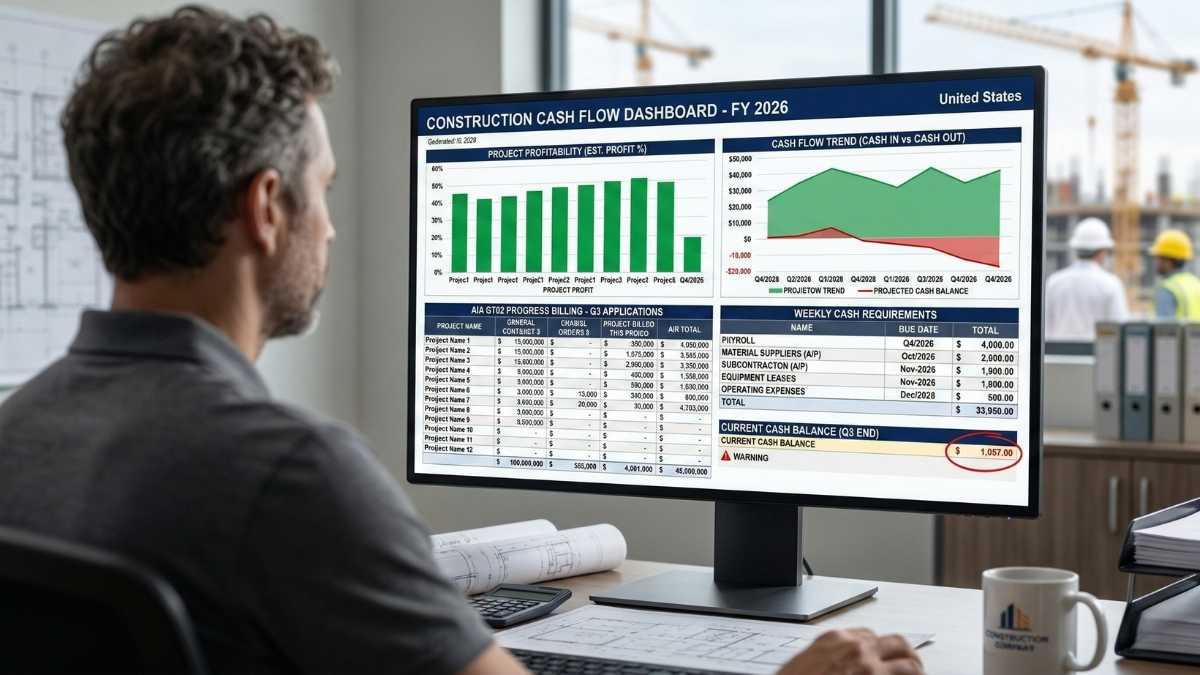
Construction cash flow in the United States construction industry, one of the most misunderstood realities is that profitability does not guarantee survival. In 2026, contractors are still going out of business while working on projects that are technically profitable on paper. The reason is not pricing. It is not demand. It is not even execution quality. The real issue is cash flow — or more precisely, the lack of control over it.
Most contractors focus heavily on estimating and winning jobs, but very few build structured systems to manage how money moves during the project lifecycle. Payments are expected based on progress, but delays in approvals, disputes, retention, and administrative inefficiencies create gaps between when work is performed and when money is received. These gaps are where businesses collapse.
Cash flow problems do not appear suddenly. They build gradually through small imbalances — delayed invoices, underestimated costs, unapproved change orders, and poor coordination between schedule and billing. Over time, these imbalances accumulate, creating financial pressure that affects payroll, supplier relationships, and the contractor’s ability to sustain operations.
The critical point is this:
Profit is theoretical.
Cash flow is survival.
And without control over cash flow, even the best projects can break a contractor.
WHAT CASH FLOW REALLY MEANS IN CONSTRUCTION
Cash flow in construction is not simply the difference between income and expenses. It is the timing mismatch between when costs are incurred and when payments are received. Contractors typically spend money before they get paid — paying for labor, materials, equipment, insurance, and overhead while waiting for progress payments that may take weeks or months to process.
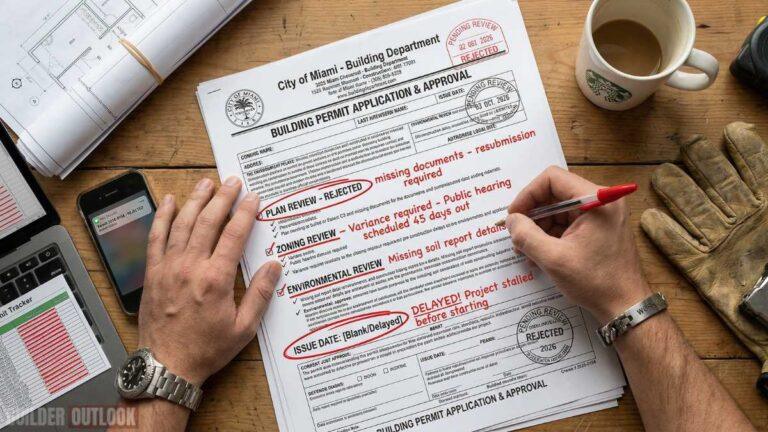
In the U.S., payment structures are often tied to pay applications, which require approval from owners, architects, or construction managers. These processes are influenced by contract terms, documentation accuracy, inspection approvals, and sometimes bureaucratic delays. Organizations such as the Associated General Contractors of America frequently highlight cash flow as one of the most critical challenges for contractors, especially in large or complex projects.
The problem is not just delayed payment — it is the lack of predictability. Contractors often operate without a clear projection of incoming and outgoing cash, making it difficult to plan and respond to financial pressure. This creates a reactive environment where decisions are made under stress rather than strategy.
Cash flow is not accounting.
It is operational control.
WHY CONTRACTORS STRUGGLE WITH CASH FLOW IN 2026
The construction landscape in 2026 has intensified cash flow challenges. Projects are faster, margins are tighter, and financial exposure is higher. At the same time, supply chain variability, labor shortages, and regulatory requirements create additional uncertainty that directly impacts both costs and timelines.
One of the main reasons contractors struggle is overreliance on projected revenue. Many assume that if a project is profitable, the cash will naturally follow. However, delays in approvals, disputes over scope, and retention policies create significant gaps between earned revenue and actual cash received.
Another critical issue is poor alignment between scheduling and billing. Work may be completed, but if it is not properly documented or aligned with the pay application structure, it cannot be billed efficiently. This disconnect creates situations where contractors are financially exposed despite making progress in the field.
Additionally, many contractors lack structured financial tracking systems. Expenses are recorded, but not analyzed in relation to incoming payments. This makes it difficult to identify risks early and take corrective action before problems escalate.
Cash flow problems are rarely caused by a single factor.
They are the result of systemic lack of control.
WHERE CASH FLOW BREAKS CONTRACTORS
Cash flow breakdowns typically occur in predictable areas, yet many contractors fail to address them proactively. One of the most common points of failure is payroll. Labor costs are continuous and unavoidable, and delays in payment can quickly create situations where contractors struggle to meet payroll obligations, forcing them to use reserves or external financing.
Another critical area is supplier relationships. Materials often need to be purchased upfront, and delayed payments can strain relationships with suppliers, leading to reduced credit terms or higher costs. This further tightens cash flow and limits operational flexibility.
Retention is another major factor. In many contracts, a percentage of payment is withheld until project completion. While this is standard practice, it creates a significant financial gap that contractors must absorb throughout the project.
Change orders also play a major role. When additional work is performed without timely approval and billing, contractors effectively finance the project themselves. This increases financial exposure and reduces liquidity.
Finally, delays in pay applications can create cascading effects. A single delayed payment can disrupt the entire financial cycle, affecting multiple projects simultaneously.
Cash flow does not fail in isolation.
It fails in chains.
Builder Inteligence


HOW HIGH-LEVEL CONTRACTORS CONTROL CASH FLOW
Contractors who maintain financial stability do not rely on luck or client reliability. They build structured systems that provide visibility, predictability, and control over cash flow. This begins with accurate forecasting, where incoming and outgoing cash is projected based on real data, not assumptions.
The first key principle is alignment between schedule and billing. Every activity in the schedule is connected to a billing milestone, ensuring that progress translates directly into revenue. This reduces delays and improves cash predictability.
The second principle is disciplined documentation. Work completed is immediately documented, verified, and prepared for billing. This minimizes approval delays and strengthens the contractor’s position in case of disputes.
The third principle is strict control over change orders. Additional work is not performed without proper documentation and approval, ensuring that all costs are accounted for and recoverable.
The fourth principle is expense management. Contractors track not only total costs but also their timing, ensuring that spending aligns with expected cash inflows.
The fifth principle is communication. Clear and consistent communication with clients, architects, and project managers helps prevent delays and resolve issues quickly.
This level of control transforms cash flow from a risk into a strategic advantage.
REAL EXAMPLE: A PROFITABLE PROJECT THAT NEARLY DESTROYED A COMPANY
A mid-sized contractor in California was executing a commercial project with strong projected margins. The project was well-estimated, and execution in the field was efficient. However, the contractor failed to implement a structured cash flow system.
Pay applications were submitted late due to incomplete documentation, and several change orders were performed without formal approval. At the same time, labor and material costs continued to accumulate.
As payments were delayed, the contractor began using internal reserves to cover expenses. Over time, this created financial pressure that affected other projects and overall operations. Despite the project being profitable on paper, the company faced severe liquidity issues.
The problem was not the project.
It was the absence of cash flow control.
HOW TO BUILD A CASH FLOW SYSTEM THAT ACTUALLY WORKS
Building an effective cash flow system requires integrating financial management with project operations. Contractors must move beyond basic accounting and develop real-time visibility into how money flows through each project.
The first step is creating detailed cash flow projections. These projections should include expected payments, expenses, and timing, allowing contractors to anticipate gaps and plan accordingly.
The second step is integrating financial tracking with scheduling and billing. This ensures that progress in the field is directly linked to revenue generation.
The third step is enforcing strict billing discipline. Pay applications must be prepared and submitted on time, with complete and accurate documentation.
The fourth step is controlling change orders. Every change must be documented, approved, and billed promptly to avoid financial exposure.
The fifth step is building financial buffers. Contractors must maintain reserves or access to financing to handle temporary cash flow gaps without compromising operations.
Technology can support these processes, but it does not replace structure. The effectiveness of the system depends on how consistently it is implemented.
THE PROJECT WAS PROFITABLE — BUT YOUR CASH FLOW WASN’T
In 2026, contractors do not fail because they lack work.
They fail because they lose control of how money moves.
Those who understand cash flow as a strategic system maintain stability, protect their operations, and scale sustainably. Those who ignore it continue to operate under pressure, reacting to financial problems that could have been prevented.
The difference is not in revenue.
More from Builder Inteligence
Advertising

FAQ – Frequently Asked Questions
1. What is cash flow in construction?
It is the timing difference between expenses and payments.
2. Why is cash flow critical?
Because it determines operational survival.
3. Can a profitable project cause financial problems?
Yes, if payments are delayed.
4. What affects cash flow the most?
Delays, retention, and poor billing practices.
5. How can contractors improve cash flow?
By aligning schedule, billing, and cost control.
6. Do change orders impact cash flow?
Yes, especially if not approved quickly.
7. Is forecasting important?
Yes, it helps anticipate financial gaps.
8. Can technology solve cash flow issues?
It helps, but structure and discipline are essential.