Indemnification clauses in construction contracts: what contractors must understand before signing
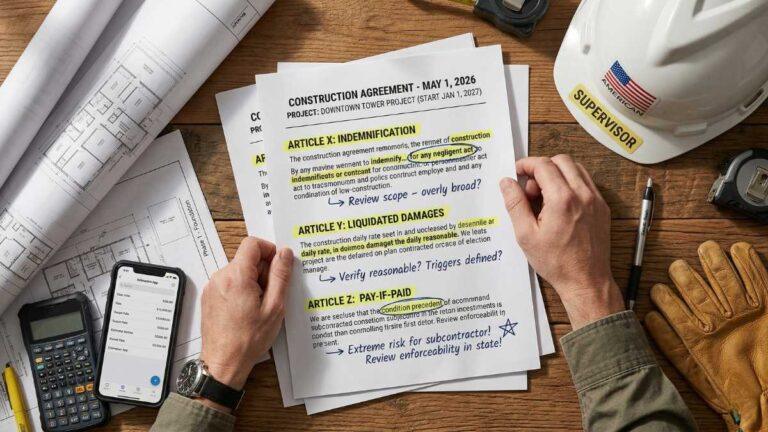
Indemnification clauses are among the most misunderstood and potentially dangerous sections of construction contracts. Many contractors focus their attention on the scope of work, pricing terms, project schedule, and payment conditions, but overlook the legal language that determines who ultimately bears responsibility when something goes wrong. In reality, indemnification provisions can significantly alter the distribution of financial risk across the project team. A poorly understood indemnification clause may require a contractor to assume responsibility for damages, injuries, or losses that extend far beyond the contractor’s own work.
In the United States construction industry, indemnification clauses appear in nearly every contract, particularly in agreements between owners and general contractors or between general contractors and subcontractors. These clauses are designed to allocate liability between parties if certain events occur during the project, such as property damage, personal injury, or legal claims arising from the construction process. While indemnification provisions are common, their wording can vary dramatically, and the specific language used in a contract determines how far the contractor’s obligations extend.
Contractors who sign contracts without fully understanding indemnification clauses may unintentionally accept liability that their insurance policies do not cover. This creates a dangerous situation in which the contractor becomes financially responsible for claims that exceed available insurance protection. In large construction projects where multiple parties interact on the jobsite, this risk can become extremely significant.
For this reason, experienced contractors treat indemnification clauses as critical risk management provisions rather than routine legal language. Understanding how indemnification works allows contractors to negotiate fair risk allocation, verify that insurance coverage aligns with contractual obligations, and avoid accepting responsibilities that should properly belong to other project participants.
What indemnification means in construction contracts
Indemnification is a legal concept that requires one party to compensate another party for certain losses or damages that may arise during a project. In construction contracts, indemnification provisions typically require one party—often the contractor—to protect another party—usually the owner—from financial harm related to specific types of claims.
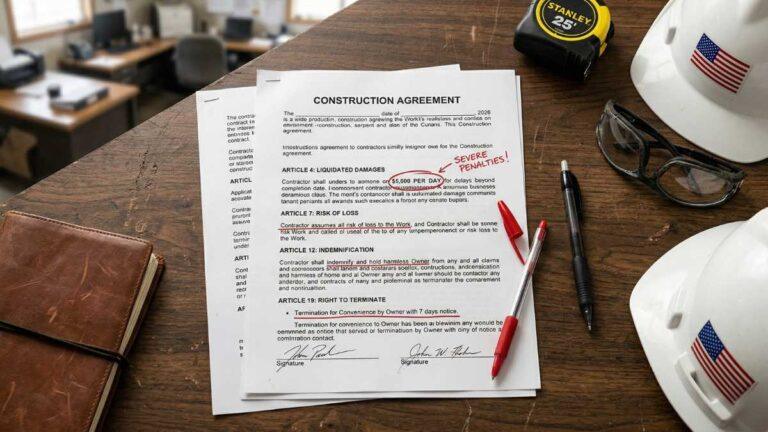
For example, a typical indemnification clause may state that the contractor agrees to indemnify and hold the owner harmless from claims arising out of the contractor’s work. This means that if a third party files a lawsuit alleging damage or injury related to the contractor’s activities, the contractor may be required to defend the owner and pay any resulting damages.
The scope of indemnification depends heavily on the exact language used in the contract. Some clauses require contractors to indemnify the owner only for damages caused by the contractor’s negligence. Other clauses attempt to extend that responsibility much further, sometimes requiring contractors to assume liability even when the contractor is only partially responsible for the incident.
This difference is extremely important because indemnification clauses can determine who ultimately pays for legal defense costs, settlements, and court judgments. Even when insurance coverage is available, the contractor may still face increased premiums, deductible payments, and reputational consequences associated with the claim.
Types of indemnification clauses in construction agreements
Construction contracts typically contain one of three major types of indemnification provisions: limited indemnity, intermediate indemnity, or broad indemnity. Each structure allocates risk differently and can significantly affect contractor liability.
A limited indemnity clause requires a contractor to indemnify another party only for damages caused by the contractor’s own negligence. This is generally considered the most balanced approach because each party remains responsible for its own actions. If a contractor causes an accident due to unsafe work practices, the contractor would bear responsibility. However, if the owner or another party contributed to the incident, liability would be allocated accordingly.
An intermediate indemnity clause expands the contractor’s responsibility by requiring indemnification even when the contractor is only partially responsible for the incident. In this structure, the contractor may still be required to indemnify the owner even if the owner shares some degree of fault, as long as the contractor contributed to the situation in some way.
A broad indemnity clause is the most aggressive form of risk transfer. Under this structure, the contractor may be required to indemnify the owner for damages even when the contractor was not responsible for the underlying event. These clauses attempt to shift nearly all liability to the contractor regardless of fault.
Many states restrict or prohibit broad indemnity clauses through anti-indemnity statutes, particularly in construction contracts. These laws exist to prevent unfair risk allocation where contractors are forced to assume liability for events beyond their control.
How indemnification interacts with insurance coverage
One of the most critical issues associated with indemnification clauses is how they interact with the contractor’s insurance policies. Contractors often assume that if they have general liability insurance, they are automatically protected from the risks described in the contract. Unfortunately, this assumption is not always correct.
Insurance policies are written with specific coverage limits and exclusions. If a contractor agrees to indemnify another party for risks that exceed the insurance policy’s coverage scope, the contractor may be responsible for those costs personally. This situation can arise if the indemnification clause requires broader liability protection than the insurance policy provides.
For example, a contractor’s commercial general liability policy typically covers bodily injury and property damage resulting from the contractor’s operations. However, if the contract requires indemnification for design errors, professional negligence, or environmental damage, the contractor may not have coverage for those exposures unless additional policies are in place.
Contractors should therefore compare indemnification clauses carefully with their insurance program. If the contract requires indemnification for risks not covered by existing insurance policies, the contractor must either negotiate revised contract language or obtain additional coverage before signing the agreement.



Why contractors must review indemnification clauses carefully
Many contractors underestimate the long-term impact of indemnification language because the clause may appear only once in the contract and may be written in complex legal terminology. However, that single paragraph can dramatically alter the financial consequences of an accident, claim, or dispute.
If an incident occurs on a construction site involving injuries or property damage, attorneys representing the injured party will often examine the project’s contracts to determine how liability should be allocated among the involved companies. The indemnification clause becomes one of the primary tools used to determine which party must defend the claim and absorb the financial impact.
Contractors who fail to review indemnification provisions carefully may unknowingly accept responsibilities that extend beyond their operational control. For example, a contractor might agree to indemnify the owner for jobsite incidents involving subcontractors, design consultants, or third-party suppliers. Without proper contractual safeguards, the contractor may be forced to absorb costs associated with actions performed by others.
Because of this risk, contractors should treat indemnification clauses as a major part of contract negotiation rather than an administrative detail.
Negotiating fair indemnification terms
Contractors are not powerless when negotiating indemnification provisions. While many owners present standardized contract templates, these documents are often negotiable, particularly when contractors can explain the risk implications clearly.
The most balanced approach is typically a mutual indemnification structure where each party is responsible for damages caused by its own negligence. This aligns legal responsibility with operational control and prevents one party from absorbing disproportionate liability.
Contractors should also ensure that indemnification obligations are limited to damages caused by their work and that they are not required to indemnify another party for that party’s own negligence. This is particularly important in projects involving complex coordination between designers, engineers, construction managers, and multiple subcontractors.
Another important negotiation point is ensuring that indemnification obligations are limited to the extent permitted by applicable state laws. Many states enforce anti-indemnity statutes designed to prevent excessive liability transfer in construction contracts.
Understanding these laws can strengthen a contractor’s negotiating position when reviewing contract language.
Why indemnification awareness protects contractors
Contractors who understand indemnification clauses are far better equipped to manage legal risk and protect their companies from unexpected financial exposure. Instead of accepting contract language blindly, these contractors analyze indemnification provisions carefully, verify insurance compatibility, and negotiate fair terms that align with the realities of project operations.
In an industry where construction sites involve numerous participants and complex operational risks, the allocation of liability is one of the most important legal structures governing project relationships. Indemnification clauses play a central role in determining how those risks are distributed.
For contractors seeking long-term stability and professional credibility, mastering the mechanics of indemnification provisions is an essential component of responsible construction contract management.

FAQ – Indemnification clauses in construction contracts: what contractors must understand before signing
1. What is an indemnification clause in a construction contract?
An indemnification clause is a contract provision that requires one party to compensate another party for losses, damages, or legal claims related to the construction project. These clauses determine who is financially responsible if accidents, property damage, or lawsuits arise during the project.
2. Why are indemnification clauses important for contractors?
Indemnification clauses determine how legal and financial responsibility is allocated between project participants. Contractors who accept overly broad indemnification obligations may become responsible for damages or legal claims that extend beyond their own work.
3. What is the difference between limited and broad indemnity clauses?
Limited indemnity clauses require contractors to cover damages caused by their own negligence. Broad indemnity clauses attempt to shift much greater liability to the contractor, sometimes even requiring indemnification for damages caused by other parties.
4. Are indemnification clauses enforceable in all states?
Many states enforce anti-indemnity laws that restrict certain types of indemnification provisions in construction contracts. These laws are designed to prevent unfair liability transfers where contractors are required to assume responsibility for damages outside their control.
5. How does insurance relate to indemnification clauses?
Insurance policies provide financial protection for specific types of risks. If a contractor agrees to indemnify another party for risks that exceed the contractor’s insurance coverage, the contractor may be personally responsible for those costs.
6. Can contractors negotiate indemnification provisions?
Yes. Contractors can negotiate indemnification language during contract discussions. Many agreements can be revised to create a more balanced allocation of liability between project participants.
7. What should contractors review before agreeing to indemnification terms?
Contractors should review the scope of liability described in the clause, verify whether insurance coverage aligns with those obligations, and confirm that the language complies with applicable state laws.
8. Why do construction contracts include indemnification provisions?
Indemnification provisions exist to clarify how financial responsibility will be distributed if claims arise during the project. They help define legal risk allocation among owners, contractors, subcontractors, and other participants.